The Pitch-Delivery Gap
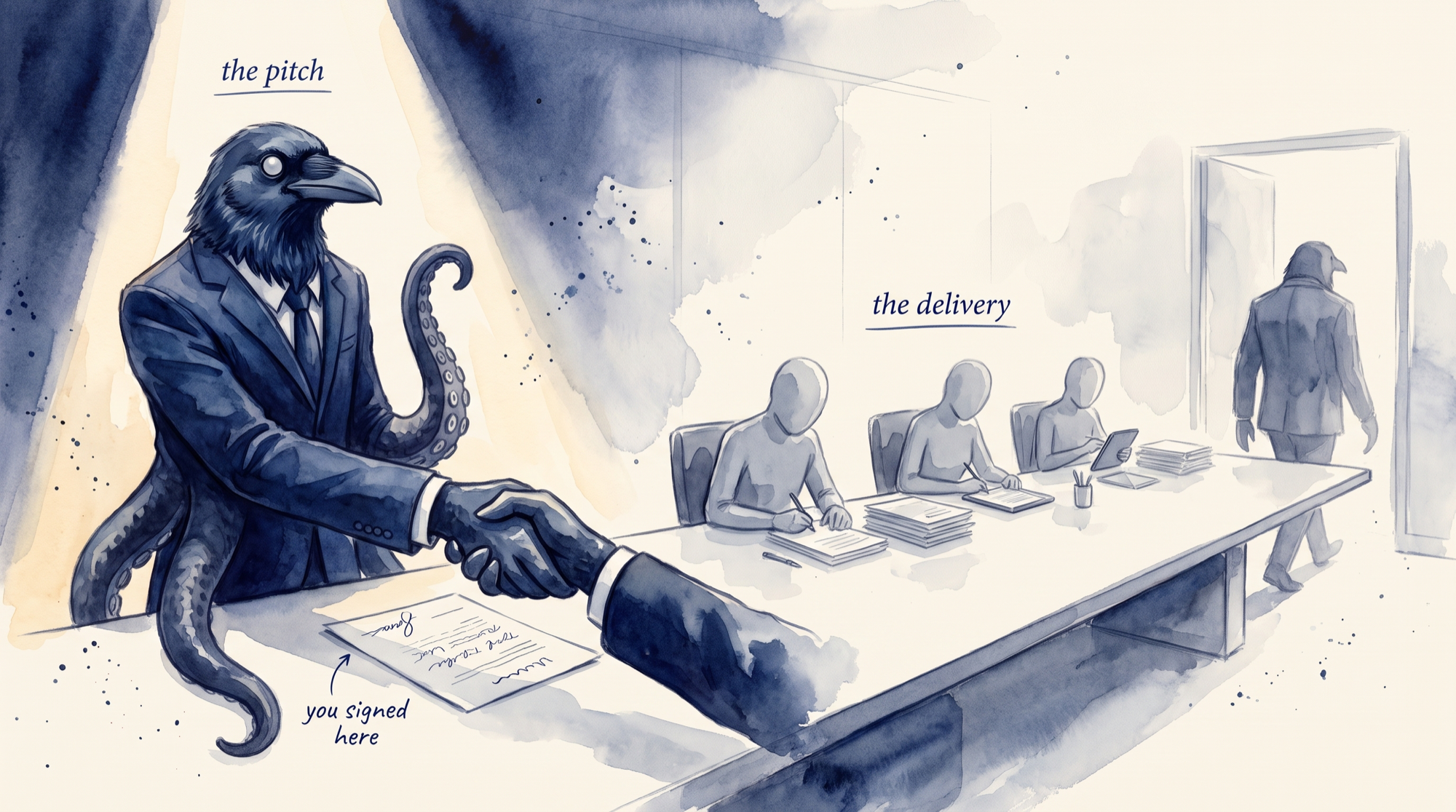
In almost every agency, the person who sells you is not the person who does your work. The senior who wins the account moves on to the next pitch; the delivery drops to juniors you never met. That distance between who is sold and who serves is the Pitch-Delivery Gap, and it is not a bad-actor problem — the economics of a human agency force it. The operator model does not manage the gap. It removes the seam entirely.
Two issues stand behind this one without needing to be reread. In Not a Freelancer, Not a SaaS I named the shape — the Agent-Staffed Function, one accountable expert with a department of specialized agents underneath, defined by where accountability sits rather than by headcount. This issue is about why that shape produces better work than the model it replaces, and the answer turns out to be almost embarrassingly simple. It comes down to a seam that every traditional agency carries and almost never says out loud.
Here is the seam. In nearly every agency you have ever hired, the person who sold you is not the person who does your work.
You met the founder, or a senior partner, or a polished strategy lead. You were impressed — rightly, because that person was genuinely sharp, and impressing you was their job. And you did more than take the pitch on faith: you saw the portfolio, the case studies, the client logos, maybe you took a reference call. That is real evidence, and it is the most any buyer gets before signing. But look at what all of it actually measures. The case study is the agency's best work, on its best account, with its best people — curated by the same senior layer that is pitching you. The logos tell you who signed, not who delivered. Every artifact answers is this agency capable? None of them answers the only question that governs your experience: who, specifically, will do my work once the senior moves on? You evaluated the agency's capability. You never evaluated your delivery team — because you were not shown it. And somewhere in the first few weeks, the senior receded to the next pitch and your actual work settled onto people you never met: a junior account manager, a rotating pool of executors, a coordinator relaying your feedback to someone you will never speak to. The work you bought and the work you got were produced by different people. You just could not see the swap happen, because it happened after the contract was signed — in the space your evidence never covered.
Selling and delivering were never the same job
Start with the thing agencies are organized around, which is that winning an account and servicing an account are two entirely different activities with two entirely different incentive structures.
Selling rewards polish, narrative, senior presence, the confident answer in the room. It is front-loaded and episodic — you do it hard for a few weeks and then it is done. Delivering rewards consistency, attention, unglamorous follow-through, and a great many hours spread over months. The skills barely overlap, and more importantly the economics barely overlap. The hour a senior spends delivering your work is an hour they are not spending winning the next account, and winning the next account is where the growth is. So the agency does the rational thing: it spends its scarcest senior hours on the pitch, and staffs your delivery with people earlier in their careers — often just as capable and just as committed, but not the ones you evaluated, and not yet carrying a senior's judgment. The point was never that those people are worse. It is that they are different — and that you never got to assess them.
None of this requires anyone to be cynical. A perfectly well-meaning agency, run by people who genuinely want to do good work, arrives at the same arrangement, because the arrangement is not a choice about ethics. It is a choice the cost structure has already made.
The Pitch-Delivery Gap
The Pitch-Delivery Gap is the distance between the person who is evaluated during the sale and the person who does the work after it — between who you assessed and trusted, and who actually shows up on your account.
Notice what the gap is not. It is not incompetence; the juniors doing your work may be talented and trying hard. It is not fraud; nobody lied to you, exactly — the senior really was that good, they simply are not the one delivering. And it is not solved by a better agency, because the better agency has the same gap; it just papers over it more gracefully, with a slicker account manager and a nicer onboarding deck. The gap is not a symptom of a bad agency. It is a structural property of the agency form itself, and once you see it you start to notice that most of the specific complaints people have about agencies are really just this one gap wearing different clothes.
Why nearly every agency pathology is this gap in disguise
Think about the standard grievances and where they actually come from.
The work drifts from what the pitch promised — because the people who made the promise are not the people executing it, and intent degrades across a handoff. Turnaround slows and things sit in a queue — because your account is one of many competing for the attention of a delivery layer that was deliberately kept lean. The senior strategist who dazzled you is suddenly hard to get on a call — because their calendar was always going to be reallocated to the next sale the moment your ink dried. Feedback goes into a coordinator and comes back subtly wrong — because it is traveling through people, and every relay loses a little signal. You are paying senior-strategist prices for junior-executor output — because the blended rate was engineered to look like the former while being staffed like the latter.
Every one of those is the same defect. They are not five problems; they are one seam, felt in five places. Which is why fixing them one at a time never quite works: you can hire a better account manager and buy a faster project-management tool and add a weekly senior check-in, and the account will feel marginally better, but the gap is still there, because you have improved the bridge across the seam without removing the seam.
"But isn't the agency accountable anyway?"
The fair objection is that none of this should matter, because someone is still answerable. The agency is contractually on the hook for what it delivers, and there is an account executive whose entire job is to own your relationship. If the work slips, you have somewhere to escalate. So why should it matter who actually holds the pen?
Because accountability and capability are not the same thing, and the gap lives in the distance between them.
Accountability is a remedy, not a guarantee. It governs what happens after the work disappoints — you can escalate, withhold, renegotiate, walk. What it cannot do is put senior judgment into the work in the first place. And the cost of using the remedy is so high — re-briefing a new agency, eating the lost quarter — that most buyers quietly absorb work that is merely fine rather than trigger it. A remedy you rarely reach for is a weak governor of quality, even when it is genuinely there.
An account executive can be admirably, genuinely accountable and still not close the gap, because what they are accountable for is coordinating the work, not doing it. They can chase the people who might fix your strategy; they cannot become those people. Accountability for a handoff is not the same as the handoff not being there.
And accountability spread across a seam thins out. When a senior set the direction and someone else executed it and the result drifts, who is answerable — the senior, who says the brief was sound, or the executor, who says they delivered the brief they were handed? Both are half-right, which is another way of saying no one is fully answerable. Split delivery produces split accountability. A single accountable operator is different not because they are more honest, but because there is no seam for responsibility to leak across: when one person is evaluated, does the work, and answers for it, accountability and capability are finally the same thing — and you are no longer trusting a remedy to make up for a gap you were never shown.
What the operator model actually removes
The reason an operator-led function feels different is not that the operator is heroic or works harder. It is that there is no seam to bridge, because there is only one person on the accountable side of it.
In an Agent-Staffed Function, the expert you evaluate during the sale is the expert who owns the delivery, and beneath that expert is a layer of specialized AI agents doing execution rather than a layer of junior humans. That single fact changes the incentive math completely. The operator cannot point their best person at your pitch and someone else at your work, because they are the same person. They cannot let your feedback degrade across a relay, because there is no relay. They cannot quietly reallocate the senior attention you bought, because the senior attention is not a resource being auctioned across accounts — it is the whole operation. The work you were shown and the work you receive are produced by the same hands, and you can verify that continuously, not just hope for it.
This is also why the agent layer matters and is not a gimmick. The old reason for the junior layer was capacity: one senior person simply cannot execute everything a real marketing function needs, so the hours had to be filled by cheaper humans, and quality was the thing traded away to fill them. The specialist agent layer removes the reason the trade existed. The operator keeps the accountable, evaluated, senior judgment on top and pushes the volume of execution down into agents that do not degrade the work the way an under-supervised junior does. You get the senior you assessed and the throughput you needed, without the swap in the middle that used to be the price of both.
"Doesn't this just move the swap — from juniors to agents?"
Turn the argument on my own model and here is its hardest form: you evaluate the operator, but the agents do the work — so haven't I just described a new swap, with agents playing the part of the juniors?
It is the objection I most have to answer, so let me answer it plainly. An agent is not a second accountable party the way a junior is. A junior is a different person — with their own reading of your brief, their own incentives, their own career pulling their attention across other accounts. Your work is delegated to them and your intent relayed, and that relay is where the signal is lost. An agent is not someone your account is handed to; it is an instrument the accountable person operates. There is no second mind quietly reinterpreting what you asked for, no competing incentives, no calendar reallocating your attention to a larger client. The judgment you evaluated is in the work because the person you evaluated is the one driving the tools and signing the output.
That is the honest boundary, though: it holds only while the operator actually applies that judgment — reading, editing, owning every output — rather than passing agent work through unread. The structure makes that possible, one person with no seam; it does not make it automatic. So the model does not abolish the need for senior judgment in the work. It removes every reason that judgment used to get separated from the work — and when it fails, it fails in the open. A lazy operator produces visibly worse work, under their own name, where you can see it. The old swap was invisible by design. This risk you can watch in the work itself, week to week — which is the whole difference.
The receipt
The most honest receipt I can hand you for this argument is the argument itself.
You are not reading a capabilities deck that a partner wrote to win you and an associate you have not met will later execute. You are reading the actual work of the person who would do your work. The Engine Log is not marketing about the operator model; it is the operator model, running in public — the same voice, the same hands, the same judgment you would get on an engagement, produced with no team behind the curtain and no handoff waiting after signature. When I argue that the pitch and the delivery should be the same act, the piece you are reading is that claim demonstrated rather than asserted: the pitch and the delivery are, right now, the same document.
Beneath that, the operating receipt is structural, not a highlight reel. Every function I run has exactly one accountable human in it — no account manager, no delivery pool, no handoff after signature — so there is no version of the relationship in which a senior wins the work and a junior inherits it. That is true on day one, before any result exists to point to, and that is precisely the point: the gap I have been describing is a property of structure, and so is its absence. You do not have to trust an outcome to verify it. You only have to ask who is on the other side of the table.
Where this reaches its limit
I want to be precise about what this does and does not claim, because the honest version is more persuasive than the triumphant one.
The operator model does not abolish the constraint that made agencies split the roles in the first place; it relocates it. A single accountable human still has finite hours, and there is real work — a national broadcast production, a simultaneous multi-market launch, anything that genuinely needs many senior hands in the same week — where a well-run team with a managed handoff will out-deliver a solo operator with agents. On that class of work, the seam I have spent this issue criticizing is a feature: coordination is the job. The operator model is not a claim that one person plus agents beats every team at everything. It is a claim about a large and fast-growing class of ongoing marketing work where the junior layer was never adding quality in the first place — it was filling capacity — and where removing the handoff removes a defect without removing anything you were actually paying for.
And there is a fair objection in the other direction: doesn't the operator just become the bottleneck? Sometimes, yes. The difference is that an operator's bottleneck is visible and yours to evaluate, whereas an agency's gap is hidden and staffed around. I would rather buy a ceiling I can see than a swap I cannot.
The old model asked you to trust that the person who impressed you and the person who serves you are close enough to the same thing. For fifteen years that was simply the cost of hiring expertise you could not build in-house. It is not the cost anymore. When the execution layer is agents instead of juniors, one accountable expert can hold the whole function, and the person you buy can finally be the person you get.
In one paragraph, and a few common questions
In one paragraph: In almost every agency, the senior person who sells you the engagement is not the person who delivers it — the account drops to juniors you never evaluated, and the distance between who you assessed and who actually serves you is the Pitch-Delivery Gap. It is not dishonesty; the economics of a human agency, where senior time is scarce and the retainer is fixed, make selling with seniors and delivering with juniors the only profitable arrangement, which is also why most agency complaints — drift from the pitch, queues, vanishing senior attention, degraded feedback, senior prices for junior output — are all the same seam felt in different places. An operator-led, agent-staffed function closes the gap not with better intentions but by structure: the expert you evaluate is the expert who delivers, with specialized AI agents handling execution instead of a junior layer, so there is no handoff to lose the work across. The limit is honest — a solo operator still has finite hours, and genuinely many-hands work still favors a coordinated team — but for the large class of ongoing marketing work where the junior layer only ever filled capacity, the person you buy can finally be the person you get.
Is the senior-sells, junior-delivers model just how agencies work? Yes, and that is the argument, not a rebuttal to it. The split is the design, not an abuse of it, because senior time only stays profitable when it is spent selling rather than delivering. Removing the gap therefore requires a different structure, not a better-behaved agency.
How does the operator model close it? By collapsing the two roles into one accountable person, with a layer of specialized AI agents doing execution beneath them instead of junior humans. No second team means no handoff, and no handoff means the work you were shown is the work you receive.
Doesn't the operator just become the bottleneck? It is a real ceiling, and the model does not pretend otherwise. The distinction is that an operator's limit is visible and yours to evaluate up front, while an agency's gap is hidden and staffed around after you have signed.
Is this the same as the Agent-Staffed Function? They are two halves of one idea. The Agent-Staffed Function names the structure; the Pitch-Delivery Gap explains why the structure wins — it is the specific defect in the old model that the new structure removes.
— Linara Bozieva, Founder, Ravenopus