Price Is the Loudest Thing You Say
Change one number on a page and every word on that page means something different. Mass market and premium are not adjectives in a brand document that no buyer will ever read; they are a number, and it is the only part of your positioning visible without taking your word for anything. Which means a repositioning that does not touch the price is not a repositioning, and a company with no brand to absorb it can move itself down-market by accident, in a single discounting decision. The argument comes with a concession that turns out to be the most useful thing in it: on the evidence, brand outranks price as a quality signal, in a meta-analysis and again across thirty-eight nationalities. That is not a problem. Brand takes a decade of not changing. The price is a decision you can make on Tuesday, which makes it the strongest lever you can actually pull.
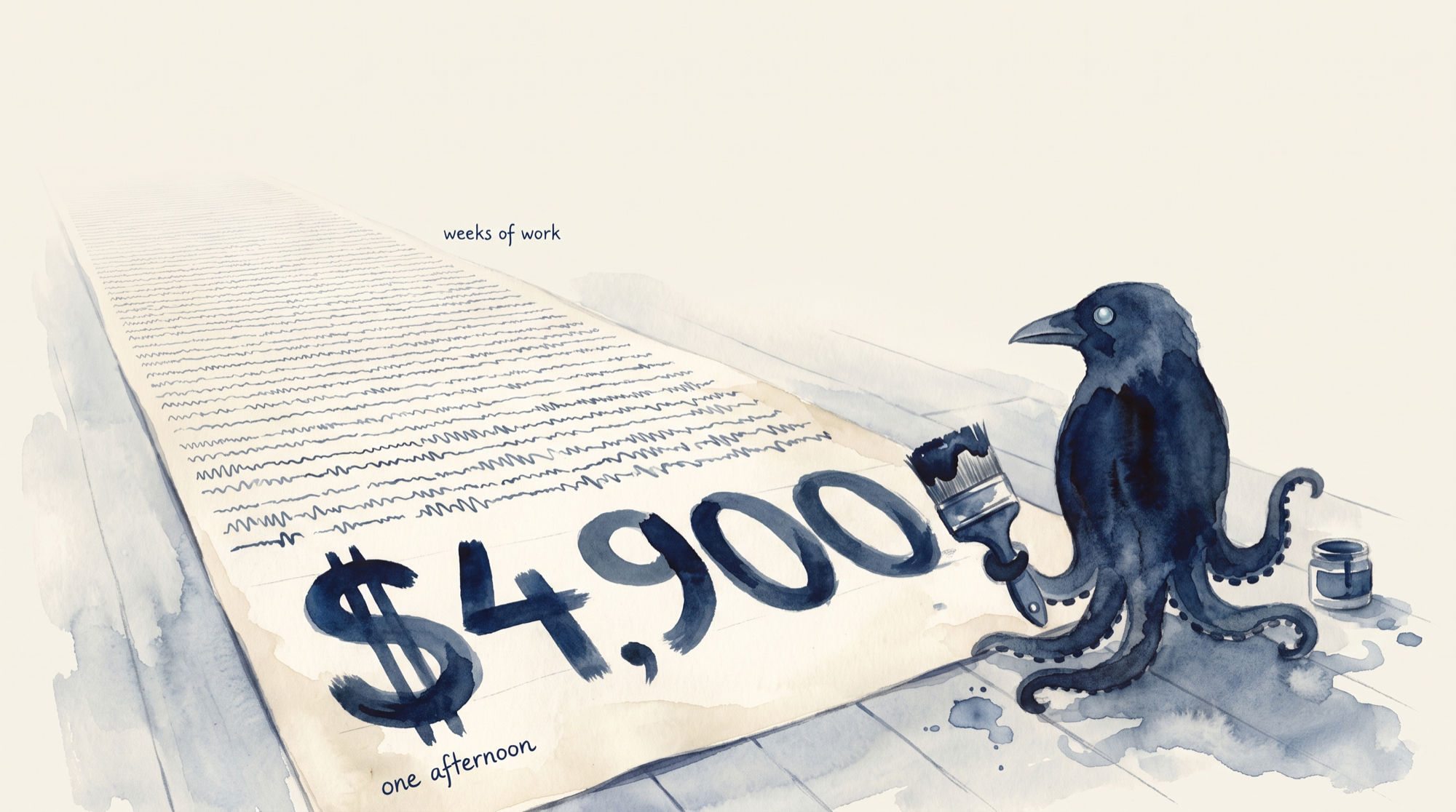
Take any page you have shipped and change nothing on it except the number.
At forty-nine dollars it is a tool. Somebody buys it on a Tuesday afternoon without asking anyone. At four thousand nine hundred it is a system, and the same buyer now wants to know what happens if it does not work. At forty-nine thousand it is a partnership, and before anything else they want to know who else uses it.
The headline did not change. The proof did not change. The photograph did not change. Nobody was persuaded of anything. The page was simply re-read, and it now says something it did not say an hour ago.
That is what I mean by loudest, and I want to narrow the word immediately, because the obvious reading of it is one the evidence does not support. I do not mean that price is the strongest signal of quality a buyer uses. It is not, and the research showing it is not turns out to be load-bearing here. I do not mean that price is the first thing the eye lands on, either. There is no good evidence for that, and I went looking for it specifically. I mean something narrower and harder to argue with: price is the claim that changes the meaning of every other claim. It is the sentence your other sentences get read through.
If that is true, then pricing is not a finance decision that marketing has to accommodate. It is the primary creative act, and the one every company performs before it has written a word.
Mass market or premium is a number, not an adjective
Every brand strategy document I have ever read contains adjectives. Accessible. Premium. Considered. Professional. Approachable but serious. These words are chosen carefully, argued over for weeks, and they reach the buyer through no mechanism whatsoever. Nobody outside the company will ever read them.
The number reaches the buyer immediately, and it carries the same information in a form they cannot ignore, cannot discount as marketing, and do not have to take your word for.
A buyer who sees forty-nine dollars has filed you before reading your first sentence. That filing is not a rough approximation of your positioning that your copy then refines. As far as that buyer is concerned, it is your positioning, because it is the only part of it visible without trusting you about anything. Everything else on the page is you asking to be believed. The number is the one thing you have already done.
This is why the same words can be a mass-market page or a premium page, and it is also why the most common repositioning exercise in marketing does not work. A company decides it has been underselling itself. It rewrites the site, commissions better photography, sharpens the language, moves upmarket in every respect except the one the buyer reads first. Six months later nothing has moved, and the diagnosis is usually that the new message needs more time or more distribution.
The message was never the problem. A repositioning that does not touch the price is not a repositioning. It is a redecoration, performed underneath a sign that still says what the old sign said.
The reverse is equally true and considerably more uncomfortable: a company can reposition itself by accident, in one meeting, by discounting. Nobody in that meeting thinks of themselves as changing the brand's position in the market. They think of themselves as responding to a soft quarter.
A price increase can raise demand, and the exception is the important half
Everything above is one short step from the worst advice in marketing, which is to raise your prices because premium signals quality. So before going further, here is the strongest real-market evidence I know, including the half that constrains it.
Ayelet Gneezy, Uri Gneezy and Dominique Olie Lauga ran an experiment at a small California winery with ordinary tasting-room visitors who had no idea they were in a study. Real bottles, real money, six hundred groups. They varied the price of two Cabernets across ten, twenty and forty dollars.
For the good wine, the 2005, sales went up when the price went up: 73 bottles at ten dollars, 113 bottles at twenty. That is an upward-sloping demand curve in a real market with real money, which is rare enough to be worth pausing on. At forty dollars, demand collapsed to 28.
For the weaker wine, the 2004, demand fell with every increase. A companion experiment with a different, recruited group of tasters found something sharper, and I want to be careful about which part of it is solid. Raw liking scores for the weaker wine drifted downward as the price rose, but that drift was not statistically significant. What was significant, strongly, was whether the wine met, exceeded or fell short of what the taster had expected: at forty dollars the weaker wine fell short decisively.
That pair is the whole doctrine in one experiment. The price sets an expectation, and the product is then experienced against it. When the product clears the expectation, raising the price raised sales, up to a point that the same experiment found at forty dollars. When it cannot clear it, raising the price does not merely fail to work, it damages how the product is received. You have not made a promise your product happens not to keep. You have made your product worse.
Honest caveats: one winery, each price ran for only two days, the demand and the liking figures come from different groups of people, and the owner supplied aggregate sales rather than the underlying distribution, which the authors disclose.
So the number does not merely announce a position. It creates the conditions under which the product is experienced, and it can hold a position the product earns or destroy one it cannot.
Brand outranks price, and that is the shape of the argument
Here is where I have to give away the strongest objection to my own title, because it is real and because any reader who knows this literature will find it immediately.
If you rank the cues buyers use to infer quality, price does not come first. Brand does.
Akshay Rao and Kent Monroe's meta-analysis pulled together 36 studies and 85 effects on how buyers form quality perceptions. Price had a positive and significant effect on perceived quality, with a weighted mean effect size of .12 that they describe as moderately large. Brand name came in at .14. Store name did not reach significance at all.
Two qualifications on that, because the size of the gap is the whole point of this section. Their own word for the brand advantage is "slightly" larger, the confidence intervals overlap substantially, and they never run a test of brand against price. The price effect itself is very well established, since they calculate that nearly nine thousand null results would be needed to overturn it, but that number speaks to the price effect and not to the ordering. And the review covers laboratory studies only, which matters in a piece that polices the line between lab and field as hard as this one does.
Niraj Dawar and Philip Parker found the same order in a different kind of study, one they present explicitly as a replication of Rao and Monroe rather than as an independent check. They surveyed 640 MBA students of 38 nationalities on which signals they use to judge quality in consumer electronics. Brand name came first, price second, physical appearance third, retailer reputation last. What held across all four of their definitions of culture is the part that matters here: brand highest, retailer reputation lowest, price in between. The fourth cue was not stable, and it is worth saying so, because physical appearance outranked price for American, Danish, German and Belgian respondents. It is also self-reported signal use by young affluent adults rather than observed behavior, which is a real limitation.
So the strongest quality signal is not price. It is brand.
I think this makes the argument better rather than worse, because the gap is not in the strength of the two signals but in how fast each one can be moved.
Brand is the accumulated residue of a decade of consistent behavior. You cannot decide to have one on Thursday. Every practical lever inside it, from distinctive assets to fame to sheer duration, works on a timescale measured in years, and it works by not changing. That is the whole mechanism. A brand that can be rebuilt in a quarter is not doing the thing brands do.
Price is the same category of signal operating on a timescale of days. It is the only high-order quality cue a company can change deliberately, this week, at will, with full knowledge of what it is doing.
So the correct statement is not that price is the strongest lever. It is that price is the strongest lever you can actually pull. Where the strongest signal takes years of unchanged behavior to build, the second strongest, adjustable on a Tuesday, is the one that decides what most companies get to be in the meantime.
That is true with a condition attached, and the condition is important enough to be the next section.
The number is read against whatever the buyer already knows
There is an obvious objection to all of that, and it is the right one to make.
If Hermes dropped its prices by a factor of ten on Thursday, nobody would wake up on Friday thinking Hermes was a mass-market brand. And if a company nobody has heard of raised its prices by a factor of ten on Thursday, nobody would wake up on Friday thinking it was Hermes. They would simply stop buying. On the face of it, price cannot do the thing I have been claiming for it.
The objection holds, and the resolution is the most useful thing in this piece, because it tells you exactly when the number matters and how much. Here it is.
A price is never read in isolation. It is read against whatever the buyer already knows, and what the buyer already knows is the brand. Where there is a strong prior, the number is a single observation against years of them, and a single observation loses. Where there is no prior, the number is not one piece of evidence among several. It is the evidence, because there is nothing else in the buyer's head to weigh it against.
So the power of price as a signal falls as the brand the buyer is already carrying rises.
That reconciles everything in this piece that otherwise looks contradictory. It offers a reason, though not one the meta-analysis itself tests, for why brand might edge price in studies of that kind. It explains why the winery's weaker wine was liked less at the higher price instead of more, since raising the price of a product with no reputation to absorb it only raises the standard it gets judged against. And it explains why the companies for which price matters most are precisely the companies that have the least of everything else, which is the opposite of how pricing advice is usually distributed.
It also means price moves perception on the brand's timescale, not on price's. Hermes at a tenth of its price would not look cheap on Friday. It would look like an error, then like a rumor, and then, if the price stayed there long enough, like a different company. The brand absorbs the first shock and then metabolizes it. What looks like immunity is latency.
Which is why luxury houses have historically preferred to destroy unsold inventory rather than discount it, a practice that is indefensible on margin and perfectly rational on positioning. They are not protecting this season's revenue. They are refusing to publish a sentence it would take them a decade to retract.
The other half of the objection deserves its own answer, because it is the half that applies to most readers. An unknown company that raises its prices tenfold does not become premium; it stops selling, which is exactly what the winery's weaker wine did. That is not evidence against the number mattering. It is the number working: the claim was made, and it was rejected on the spot, because nothing else the buyer had supported it.
So the practical read for everyone who is not Hermes is that your price is your positioning, in full, immediately. You do not get the latency to absorb a bad one, and you do not get credit for a good one you cannot back.
The price is the only claim you pay for making
There is a structural reason buyers treat the number differently from the sentences around it, and once you see it you cannot unsee it in your own marketing.
Every other claim on the page is cheap to make.
"Premium" costs the price of the word. "Trusted by industry leaders" costs the price of the words plus a logo strip. "Award-winning" costs an entry fee. "Results-driven," "proven," "best-in-class," and every case study a company writes about itself cost approximately nothing, and here is the part that matters: they cost approximately nothing for a company that does not deserve them, which is exactly the same as what they cost a company that does. A claim that costs the same to make whether or not it is true carries no information, and buyers know this, which is why that entire register of copy passes through them without resistance and without effect.
A price is different in kind. Saying four thousand nine hundred dollars requires being willing to lose every buyer who will not pay four thousand nine hundred dollars, and that willingness gets paid in real forgone revenue whether or not a single person believes the claim. You cannot write the number and quietly not mean it. The market collects.
Call this the Costly Claim: the only assertion in a company's marketing whose cost to make equals what it asserts.
Economic theory has been circling this for decades, and I want to be careful about how much weight I put on it, because theory is not evidence. Asher Wolinsky, and later Paul Milgrom and John Roberts, modeled price as a quality signal. Kyle Bagwell and Michael Riordan showed why it can work: a high price is the efficient signal because the resulting loss of sales volume is most damaging to the lower-cost, lower-quality product. The cost structures differ, so the same price hurts the weaker producer more. The signal is credible precisely because it is expensive to fake. What none of these papers provide is field evidence, and I will come back to where the field evidence actually goes, because in one important case it goes the other way.
But the mechanism explains something you can observe without any research at all. A company that cannot sustain its price does not get exposed. It simply stops, because it runs out of money making the claim. A price is therefore a self-enforcing sentence, and there is nothing else on the page like it.
What the number does to the product itself
If price were only a signal, it would change what buyers expect. It does something stranger than that. It changes what they experience.
Baba Shiv, Ziv Carmon and Dan Ariely gave 125 people an energy drink and fifteen word puzzles to solve in thirty minutes. Some were charged the regular price of $1.89. Others were told the retail price was $1.89 but charged $0.89, explained as an institutional bulk purchase. Same drink, same puzzles, same room.
The people who paid the discounted price solved fewer puzzles. The effect was large, and it held up across two further experiments, though in the second it survived only in some conditions.
The popular retelling stops there, and their third experiment is where it gets interesting, because it separates two things the first two could not. That one crossed the price against the strength of the advertising claims made for the drink, with 204 fresh participants. With strong claims, the full-price group beat the no-drink control decisively, 10.1 puzzles against 6.8. With weak claims, the same full price scored 5.8, below the control, though that particular contrast is a marginal one. The discounted group came in under the full-price group both times, at 4.2 and 7.4 against 5.8 and 10.1. Worth noting that the discounted group with strong claims still beat the control: a discount reliably costs you something against what you could have charged, but it does not always leave the buyer worse off than nothing.
So the number is not doing this by itself. In that experiment the strength of the claims was the larger effect of the two, and what price did was decide whether the claims were believable. A full price with nothing behind it performed worse than a full price with a real argument attached, and worse than not drinking anything.
This is closer to the thesis of this piece than the simple version is. The price does not act on the buyer alone. It acts on everything else you said, and everything else you said acts back on it.
The wine study people usually cite alongside it is real and needs more care. Hilke Plassmann and colleagues had twenty people taste wines in a scanner, with prices displayed. The same wine presented at ninety dollars was rated more pleasant than when presented at ten, and activity in a region associated with experienced pleasantness moved with it. That result is frequently reported as brain scans proving expensive wine tastes better, and three things in the paper argue against saying it that way. They found no evidence of an effect on the primary taste regions, which suggests the price was not changing the sensation so much as the integration of it. When the same subjects re-tasted the wines blind eight weeks later, the differences vanished and pleasantness was not increasing in price. And the sample was twenty people at statistical thresholds that would not pass review today. The behavioral finding is solid. The neuroscience is suggestive, and that is all I will claim for it.
Strip both studies back to what survives and it is still remarkable, with one honest limit on how far it travels. These are undergraduates solving word puzzles after a sports drink, and twenty people tasting wine in a scanner. What they show is that the number changes how good the thing is for the person consuming it, and not merely how good they later say it was. How far that carries into a six-figure purchase made by a committee is not something either study can tell you.
The discount is a sentence, not a tactic
Almost every company I have looked at treats discounting as a lever that costs margin and buys volume, and models it accordingly: give up fifteen points of price, get some elasticity back, run the arithmetic, decide.
The arithmetic is not wrong. It is radically incomplete, because it prices only the margin.
If a discount measurably degrades how well a product performs for the person who bought it, then a discount is not a transfer of value from the seller to the buyer. It is a partial destruction of value in transit. Some of what you gave up did not arrive.
What makes the discount distinctive is not that it is the only price move carrying information. The energy-drink experiment above disproves that, since a full price with weak claims did damage of its own. It is that the discount is the only one whose information is reliably unflattering. A full price can help or hurt depending on what surrounds it. The discount underperformed the full price in every condition tested, whatever the claims around it said.
And discounts are rarely a single event. Most are a calendar. A brand that discounts every November has not run a promotion; it has published a standing claim that its November price is the real one and the other eleven months are a markup. A brand that runs a permanent twenty percent off has renamed its price and kept the old number visible as a decoration. A brand whose sale cue is always on has taught its buyers that the number means nothing, which is the one thing a price cannot afford to mean.
This is why I think the promotional calendar belongs in the creative review and not only in the revenue forecast. It does sit with marketing in most companies, and that is the problem rather than the consolation: it is owned by the half of the function measured on this quarter, it is decided one promotion at a time with every individual decision locally defensible, and it is almost never read end to end as the single repeated sentence it actually is. It is the most frequently repeated thing a company says about what its work is worth, and hardly anyone has seen a year of it written down in one place.
The last digit is a creative decision
Everything so far has been about what the number is and when it changes. The number communicates further down than that, all the way to its final character, and the evidence for it is unusually good because it is not a lab study.
In three large randomized field experiments, Eric Anderson and Duncan Simester worked with two national women's clothing mail-order catalogs owned by the same parent, real customers, real money, randomized by postal code. The product did not change and neither did the photograph. What they varied were prices, and their model then isolates the effect of the ending from the effect of the level, which is how a last digit becomes measurable at all.
In the first experiment, across 73 test items and three catalog versions mailed to twenty thousand customers each, a price ending in nine produced a demand increase of roughly thirty-five percent. In the second, across 120 test items and 31,250 customers per version, the effect was about fifteen percent, an extra 1.3 units on a base of 8.7 per item. New items gained more than established ones, twenty-two percent against ten. In the third and largest, 308 items across three versions of ninety thousand customers each, the effect was smaller at about seven percent, and honestly it wobbles: in one specification it does not reach significance.
Two things in that study are worth more than the headline.
The first is a trap I nearly walked into and the authors did not. In the first two experiments the coefficient on the price level was not statistically significant while the coefficient on the last digit was, which invites the conclusion that customers respond more reliably to how a number is written than to how large it is. The authors raise that reading and immediately warn against it, on the grounds that those studies varied price too little to identify a price effect. By the third study, which varied 218 prices instead of 43, the price coefficients are significant at better than one percent. The level matters. The earlier nulls were a shortage of statistical power, not a discovery.
The second is that in the third experiment a "Sale" cue outperformed the nine ending, and the authors write plainly that customers are more sensitive to that cue than to the price ending. Adding a nine ending to a new item that already carried a sale cue gained almost nothing. They put that in the abstract rather than burying it, which is most of why I trust the rest of the paper.
I take the qualification seriously and the finding stands anyway. The last digit of a number, with the product and every word around it held constant, moved real purchases by real people in three experiments. It is typography with consequences. And unlike the price itself, this part is already yours: in every company I have worked with, endings, sale cues and the promotional calendar sat with marketing and merchandising, which means one of the few price-presentation effects anyone has measured in the field describes a decision marketers already own and mostly treat as an operational detail rather than a creative one.
The part that actually sits outside your brief is the level
Now the uncomfortable part, and it is the ask this whole piece has been building toward.
The presentation of the price, as the last section argued, mostly belongs to marketing already. The level does not. In most companies the level is not set by anyone whose job is communication. It is set in finance, or in product, or by the founder in a spreadsheet, and it arrives at the marketing function as a given. The brief says positioning, creative, channels, budget. It does not say what the thing should cost. The marketer's job begins after the sentence that decides the category has already been written by someone who was not thinking of it as a sentence at all.
I do not think this is stupid. Price carries constraints that marketing genuinely cannot see: cost of goods, margin structure, channel conflict, contractual floors, cash timing, what the board was told last quarter. A marketer who treats price as a free creative variable can destroy more value in one decision than a year of campaigns can generate. The instinct to keep it away from the people who are paid to be persuasive is a defensible instinct.
But notice what the arrangement produces. An entire discipline has organized itself to optimize every variable downstream of the one with the most leverage, and has accepted that the upstream variable is somebody else's. We own the last digit and test headlines that move conversion by points, while the number that decides whether we are a tool or a partnership is set in a meeting we do not attend. And because nobody in that meeting is thinking about meaning, the loudest line in the company's marketing is routinely written without a single person asking what it says.
The fix is not that marketers should set prices on their own. It is that somebody in that room has to be responsible for what the number means as well as for what it earns, and that job currently belongs to nobody.
Two stories everyone tells, and neither one is evidence
If you have read anything about pricing psychology you have met both of these, and they are the two most-cited proofs in the entire subject.
The first is Chivas Regal. A struggling scotch doubles its price without changing the liquid, and sales double. It is in textbooks. It has a named effect attached to it. It has no primary source. Every trail leads to another retelling of the same story with no original underneath it, and the surrounding facts make it unusable even if it happened: Seagram acquired the brand in 1949 and simultaneously escalated advertising spend and distribution, so a price rise and a sales rise in the following years are hopelessly confounded with a marketing and distribution push. It is not a weak study. It is not a study.
The second is the turquoise jewelry story from Robert Cialdini's Influence. A shop owner leaves a note to halve the price of a slow-moving lot, the assistant misreads it as double, and the lot sells out. It is an anecdote about a friend's store, with no data, no records, and no independent verification of any kind.
I am not raising these to score a point about other people's sourcing. I am raising them because the strength of the belief in price-as-quality-signal is disproportionate to the evidence for it, and these two stories are most of why. They are vivid, they are memorable, and they are doing the work that ought to be done by the winery experiment and the meta-analysis, both of which are real, both of which are more qualified, and neither of which is as good a story.
The belief is far stronger than the two stories holding it up, and the real evidence, which is more qualified and a good deal less quotable, has been doing none of the work.
Where this is wrong
I want to mark the boundaries, because a doctrine without boundaries is a slogan.
Price as a psychological lever does not survive everywhere. Nava Ashraf, James Berry and Jesse Shapiro sold a household water purification solution door to door to about a thousand households in Lusaka at varying prices, with real money. They found economically meaningful screening effects, in that higher prices sorted the product toward households that would actually use it. They did not find consistent evidence for the sunk-cost psychology, the idea that paying more makes you use it more, when they checked roughly two weeks later. It is the largest field test of that effect anyone has run, and the effect a great deal of pricing folklore rests on did not show up in it.
That result bears directly on the energy drink study earlier in this piece, and I would rather set the two next to each other than quote whichever suits the paragraph. What survives the pair is the narrower claim: the discount effect on immediate experienced efficacy held across all three experiments in that paper, conditionally in the second, while the broader folk version, that paying more makes people actually use the thing, is what the Zambian field experiment went looking for and could not find. Price appears to change how good something is while you are using it. Whether it changes how long you keep using it is unproven, and the best field evidence says probably not.
And in professional services, the field evidence does not support the flattering version. This is the case most relevant to anyone reading this, so I will not soften it. Antonio Moreno and Christian Terwiesch studied more than 1.8 million bids across 270,000 software development projects on a large freelance services marketplace. What they report is a trade-off: clients are willing to pay a premium for more reputable providers, accepting higher bids when reputation is stronger. What they do not report, because they did not test it, is that a high bid on its own creates a perception of quality. Reputation earned the premium there. There is no evidence in that dataset that price manufactured it.
One caveat I owe the reader, since it cuts against my use of the study: a bid marketplace is a dense side-by-side comparison environment, which is exactly the setting where this piece says price-as-quality inference is weakest. So it is not a clean test of the services case in general. What it does establish is that where buyers can compare, they buy reputation and treat price as a cost, which is the relevant fact for anyone whose buyers can compare.
So when someone tells you that in services a high price signals quality, the accurate version is: theory predicts it, laboratory work supports it, and the largest real-market dataset available shows reputation doing the work. A high price is not a shortcut to a reputation you have not got.
The categories matter too. Price-as-quality inference lives on the buyer's inability to verify quality before purchase. In commodity categories, in dense comparison environments, in anything with a functioning review layer and a specification sheet, a high price is mostly a high price.
Which brings me to a distinction this piece has been leaning on without naming, and it is the one that stops all of the above from cancelling the argument. Your price determines what claim you are making. It does not determine whether the claim is believed. Those are different questions and most pricing advice runs them together. The number is the whole of your positioning to a stranger, in the sense that it is what they will file you under before you have said anything, and that is true in services and everywhere else. Setting it high still does not buy you a quality perception you have not earned. What it buys you is a promise you now have to keep, and the winery's weaker wine and the bidders on that marketplace are the same finding twice: the claim was made, the claim was tested, the claim failed.
So the argument does not weaken as verification gets harder or easier. It changes what it is about. Where verification is hard, the price is doing your positioning whether you meant it to or not. Where verification is easy, the price is still your positioning, and the buyer simply checks it faster.
The failure people expect, and the one that actually happens
The expected failure of this argument is that it becomes permission to charge more. It should not, and the winery experiment is why: raising a price you cannot support does not just fail to work, it degrades the product in the buyer's hands. A wrong price is a wrong claim in either direction, and expensive is not a strategy.
The failure I see far more often runs the other way, particularly in services, and it is underpricing, which is almost never described as a failure at all.
Underpricing is usually explained as a growth decision, or as humility, or as a reasonable thing to do while you build up proof. What it actually does is publish a sentence about your own work, in the one register buyers trust, before you have said anything else. It reads as a confession. And because it is the loudest thing on the page, it sets the frame through which every subsequent claim is read: the case studies are re-read as smaller, the method is re-read as lighter, and the expertise is re-read as less. You can spend the entire rest of the page arguing against your own price, and the price will win, because you paid for it and the words were free.
Nobody sets out to publish that sentence. Most companies publish it anyway, on the page they spent six weeks writing and eleven minutes numbering.
So what do you actually do
Set end to end, the findings in this piece can look like a wash. Brand beats price, except where there is no brand. A higher price raises demand, except when the product cannot carry it. Discounting degrades the experience, though a field test found no sign that it changes whether people go on using the thing. And in the one large services dataset available, reputation earned the premium rather than price creating it. It would be reasonable to finish all that and conclude that pricing is complicated and someone else's job.
It is not a wash. It is a shape, and the shape gives you a decision rule.
Price does the most work exactly where you have the least of everything else. A buyer with no prior about you has nothing to weigh the number against, so the number is the whole of your positioning. A buyer who already knows the brand reads it as one observation among many. That is not contradicted by the services finding, because those are two different claims: your price settles what you are claiming, and your reputation settles whether the claim is accepted. You always control the first one. The rule means the companies with the weakest case for obsessing over price are the ones with decades of equity, and the strongest case belongs to everyone else. If you are not Hermes, this is your lever, and it is not a small one.
So, concretely.
Write the price as a sentence before you write it as a number. Decide what you want a stranger to conclude about what you are, and then find the number that says it. Most companies work in the other direction, from cost plus margin plus a glance at two competitors, and whatever the number then means is an accident nobody chose.
Set it at the top of what the product can actually clear, and not a dollar above. The ceiling is not what the market will bear, it is what your product will survive. The question is answerable and uncomfortable: can we deliver against this promise for the next hundred buyers, not the next flattering one.
Fix the calendar before you touch the level. Endings, sale cues and the promotional sequence are already yours, and they are the part of the number you can change without winning an argument first.
Stop using discounts to solve demand problems. The discount is the only price move that always carries information, and the information is unflattering. If demand is soft, the options that do not damage the product are to change the offer, change the proof, or change who you are talking to. A discount is the one lever you pay for twice, once in margin and once in meaning.
When you cannot hold a price, treat it as product information. A number that will not stick is the market reporting that the thing underneath it is not clearing the bar. Lowering it silences the report without addressing the cause, and you lose the diagnostic along with the margin.
And if you sell services, understand which direction the causality runs. Reputation earns the premium; the premium does not manufacture reputation. That one comes from a very large real-market dataset rather than a laboratory, which is why I weight it heavily. But the inverse is not symmetrical, and it is the trap: underpricing does not buy you the reputation that would let you charge more later. It publishes a claim about your work that makes the reputation harder to build, every day that the number is up.
Most of that does require a seat in the pricing meeting, and pretending otherwise would be the comfortable version of this argument rather than the true one. That seat is the actual ask. The number is currently settled in a room where one kind of argument is admissible, the margin kind, and the argument nobody carries in is what the number is going to say to a stranger. Someone has to bring it, repeatedly, with the evidence, until it is a normal thing to raise.
The exception is the calendar, and it is worth doing first precisely because it needs no one's permission. You can put the next twelve months of promotions on one page this week and read them as a single sentence. In my experience that is the fastest way to find out that your brand has been saying something out loud for years that nobody ever chose, and it is a considerably better thing to walk into the pricing meeting holding than an opinion.
In one paragraph, and a few common questions
In one paragraph. Mass market and premium are not adjectives in a document no buyer will read, they are a number, and it is the only part of a company's positioning that is visible without taking its word for anything, which is why a repositioning that leaves the price alone is a redecoration and why a company without much brand behind it can move itself down-market in a single discounting decision. Price is not the strongest signal a buyer reads, and the two best studies we have both say brand outranks it. Price is the strongest signal you can change, this week, on purpose, which makes it the primary creative act for anyone who does not already have a decade of brand behind them. It is the only claim you pay for making, which is why it is read as evidence when the rest of the page is read as argument. It changes not just what buyers expect but what they experience, which means a discount is a partial destruction of value rather than a transfer of it, and a promotional calendar is a standing sentence about what your product is worth when nobody is watching. A price increase can raise real demand, but only when the product can clear the expectation the increase creates; when it cannot, the increase makes the product worse. None of this works in commodity categories with functioning verification, and in professional services the largest real-market study we have says reputation earns the premium rather than price manufacturing it. What is left is not a reason to despair of pricing. It is a target. Write the number as the sentence it already is, set it at the top of what the product can genuinely carry, read your own promotional year as a single message, and stop paying twice for demand you could have bought another way. Everything you write afterwards will be read through that number, so it is worth choosing it on purpose.
What is the Costly Claim? It is the only claim in your marketing that costs what it asserts. "Premium" costs the price of the word, and it costs a company that does not deserve it exactly what it costs a company that does, which is why that whole register of copy passes through a buyer without resistance. A price of four thousand nine hundred dollars costs you every buyer who will not pay four thousand nine hundred dollars, paid in real forgone revenue whether or not anyone believes you. A company that cannot sustain the claim does not get caught, it runs out of money making it. That is why the number is read as evidence while the rest of the page is read as argument.
Is price the strongest signal of quality? No, and I would rather say so than be corrected on it. A meta-analysis of 36 laboratory studies found brand name a slightly stronger cue than price, .14 against .12, close enough that the authors never test the gap. A survey of 640 MBA students of 38 nationalities put them in the same order. Price came second in both. What makes second place interesting is the timescale: brand is the accumulated residue of a decade of not changing, and price is the only high-order quality cue you can deliberately change this week. It is not the strongest lever. It is the strongest one available to almost everybody.
Does a higher price make people value something more? Only when the product can clear the expectation the price sets. At a California winery, with real buyers who did not know they were in a study, a good Cabernet sold 73 bottles at ten dollars and 113 at twenty, then collapsed to 28 at forty. A weaker Cabernet sold less at every increase, and in a companion study with a different, recruited group of tasters it was judged to have fallen short of expectations at the higher price. Raising a price raises the promise. A product that cannot meet the promise is judged against it anyway, which is the part people forget when they decide to move upmarket by changing the number.
What does a discount actually do? More than lower the margin, which is the only thing most discount models price. In a published set of experiments, people given a discounted energy drink solved fewer puzzles than people who paid full price, in every condition tested. Full price beat a no-drink control, but only when the drink came with strong claims; with weak claims the same full price scored below it. So a discount is not a transfer of value from seller to buyer; part of what you gave up did not arrive. And most discounts are not an event but a calendar, which makes them the most frequently repeated sentence a company publishes about what its product is worth when nobody is watching.
Should marketers set the price? They already set part of it. Endings, sale cues and the promotional calendar sit with marketing in most companies. The level usually does not, and that is the room nobody responsible for what the brand says tends to be in. Price carries constraints marketing genuinely cannot see, including cost of goods, margin structure, channel conflict and cash timing, and a marketer treating it as a free creative variable can destroy more value in one decision than a year of campaigns creates. The problem is not that finance sets the level. It is that nobody in that room is responsible for what the number will say, and nobody in marketing treats the half they already own as though it says anything either, and then every word the company writes is read through it.
— Linara Bozieva, Founder, Ravenopus