When Execution Is Free, Taste Is the Product
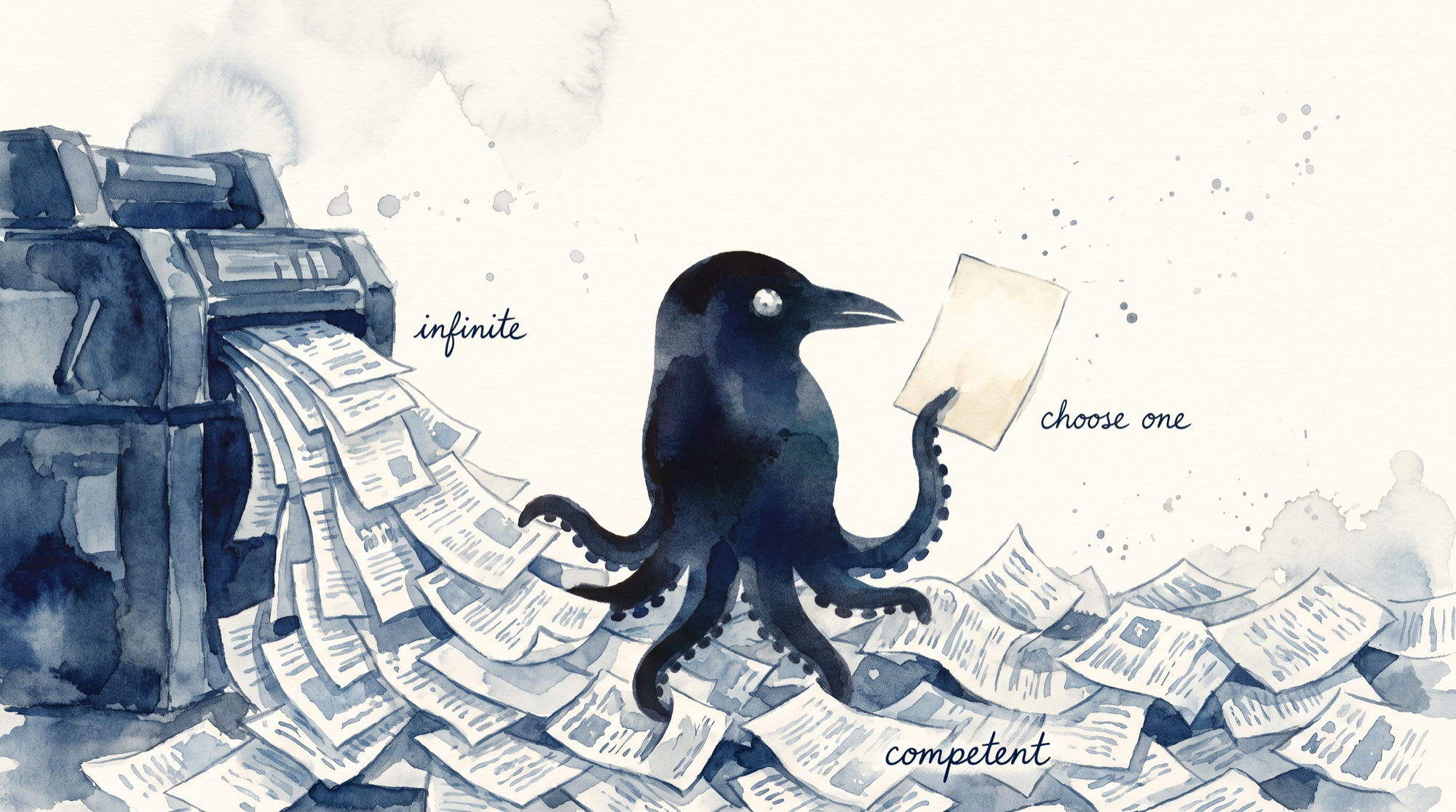
For a century, marketing's binding constraint was production: making the thing cost people and hours, and that cost gated everything. That constraint just disappeared. When the cost of execution collapses to near-zero, the value does not vanish — it relocates to whatever is still scarce, and what is still scarce is judgment. The danger is that agents do not flood you with bad work; they flood you with competent work, which is exactly what used to be sellable. When competent becomes free and infinite, the product is no longer the output. It is the taste that chose it.
For about a century, everything in marketing was gated by one cost: making the thing. A campaign needed people to produce it, and people-hours were scarce and expensive, so the cost of production quietly set the ceiling on everything else — how many ideas you could test, how much you could ship, how fast you could try again, how much you could afford to iterate. You never thought about it as the constraint because it was the water you swam in. It was simply true that good marketing required a lot of expensive human production, the way it was once simply true that a book required a scribe.
That constraint has disappeared. Not softened — disappeared. The marginal cost of producing one more competent marketing asset has collapsed toward zero, and most of the industry is still organized around a scarcity that no longer exists.
This is the piece where I say what I think that actually means, because the honest version is stranger and more demanding than the hopeful one. When the thing that used to be scarce becomes free and infinite, the value does not evaporate. It moves. And where it moves is the whole question.
The input that became free
Start with what "execution is free" does and does not mean, because the phrase invites a lazy reading.
It does not mean the work costs literally nothing, and it does not mean the output is automatically good. It means that the thing that used to gate the entire system — the people-hours required to produce another competent asset — no longer gates it. The tenth ad variant used to cost roughly what the first one did. Now the tenth is nearly free, and so is the hundredth. The draft that used to take a specialist a day exists in the time it takes to ask for it. Production, the input that priced everything above it, has fallen out of the equation as a binding limit.
When a binding constraint disappears, the system does not just get faster at the old thing. The old thing stops being where the value is. That is the part almost everyone gets wrong — they treat free execution as a discount on the work they were already selling, when it is actually a repricing of what the work is.
When a scarce input becomes abundant, value moves to the next constraint
This is not a technology observation; it is an old and reliable economic one. When an input that used to be scarce becomes abundant, its price falls to nothing, and value relocates to whatever is still scarce — the next binding constraint in the chain. Cheap steel did not make buildings worthless; it moved the value to design and engineering. Cheap printing did not make writing worthless; it moved the value from the scribe's hand to the author's judgment about what was worth setting in type.
Cheap execution does the same thing to marketing. The value does not disappear along with the cost of production. It moves up to the next thing that is still scarce, and in marketing the next scarce thing is unambiguous: it is knowing which of the infinite possible outputs is the right one. Judgment. Taste. The ability to look at what the machine can produce — which is now nearly everything — and correctly choose.
The market has not repriced this yet. That lag is the whole opportunity, and it is also the whole risk, depending on which side of it you are standing on.
The trap is that the work is competent, not bad
Here is where the comforting story falls apart.
The easy way to dismiss all of this is to say the output is slop — generic, soulless, obviously machine-made — and that discerning buyers will simply route around it. That would be reassuring if it were true. It is not. The flood is not incompetent. It is competent: clean, on-brief, grammatical, reasonable, the kind of work that a capable junior would have produced on a good day. And competent-but-generic is precisely the work that the old model used to sell for real money.
So the danger is not a wave of garbage you can wave away. It is a rising tide of perfectly fine work, produced infinitely and nearly for free, that makes "perfectly fine" worth exactly nothing. When competence is abundant, competence is no longer a product. And the only thing that remains scarce in a world of infinite competent output is the judgment to look at something competent and say this one is wrong — and be right about it.
Taste is subtraction
We should be precise about what taste even is, because the word sounds like decoration and it is nearly the opposite.
Taste is not the ability to make the thing. The machine makes the thing. Taste is the ability to stand in front of the thousand competent things the machine can make and know which one is right — and, far more often, to know that nine hundred and ninety-nine of them are wrong and let them go. It is a subtractive act. The value an operator adds is not visible in the one asset that shipped; it is invisible, sitting in the ninety-nine that were killed, the versions you will never see because someone with judgment refused to let them out.
This is exactly the part that does not transfer to the agent, and the reason is structural, not temporary. An agent optimizes for output that is plausible — that looks like the thing being asked for. It does not optimize for output that is correct, because it has no stake in the result and no way to feel the difference between fine and right. It will generate a competent version of a bad idea with the same fluent confidence it brings to a good one. The judgment about which idea deserves to exist at all sits outside the model, in whoever is driving it. Infinite production without taste is not a marketing function. It is a slop factory with good grammar.
The Taste Premium
So the thing a buyer is actually paying for has quietly inverted, and most contracts have not caught up.
The Taste Premium is the value that accrues to judgment once execution is free. When producing another competent asset costs nothing and anyone can do it, being able to produce is worth nothing — a capability everyone has commands no premium. What still commands a premium is the judgment that selects the right output from the infinite competent ones and refuses the rest. That is the product now. Not the deliverable, which is free. The taste that chose it, which is not.
You can see the mispricing everywhere the old rubric survives. Buyers still pay by the deliverable, by the asset, by the headcount, by the hour — every one of which is a way of paying for production, which is the exact thing that just became free. Paying per deliverable in an age of free deliverables is like paying a scribe per page after the printing press: you are metering the input that stopped being scarce. The repricing that is coming, and that a few operators are already running ahead of, is simple to state and hard to swallow: you pay for judgment, and judgment is measured by what gets rejected before it ships, not by how much gets shipped. This is also why, priced honestly, the model charges for the judgment and not for the volume. The price is pinned to the taste, which is scarce, so the output can keep growing without the bill moving — the client gets more, at the same price, precisely because the more was never the thing being paid for. An agency that instead charges more for more output is doing the opposite: metering the input that just became free, and quietly confessing it still believes the output was the product.
Why this is structurally the operator's game
There is a reason taste and the operator model fit together, and it is a different reason than the ones I have argued before — not accountability, not the absence of a handoff, but something more specific to judgment itself.
Taste does not survive a committee, and it does not survive a queue. Run one asset past four specialists who each have to sign off, and it does not converge on the sharpest version — it reverts to the version with the least friction, the one nobody objects to, which is reliably the blandest one in the set. Distributed judgment averages toward the inoffensive, because every hand that touches the work sands off another edge to get it approved. That is why so much agency output is competent and forgettable: not because the people lack taste, but because taste is a single coherent act and a queue is the machine that dissolves it.
An operator applies one unbroken judgment across the whole of the output, and the agent layer is what makes that finally possible at scale. The old ceiling on a single person's taste was capacity — one person could only judge as much work as one person could also produce, so past a certain volume you had to hand production, and therefore judgment, to other people, and the coherence broke. Agents remove that ceiling. The operator no longer has to produce the work in order to judge it, so a single taste can now govern a volume of output that used to require a whole team and, in requiring the team, used to lose the very thing it was scaling. The agents supply infinite competent production. The operator supplies the one thing agents structurally cannot: the judgment about which of it deserves to exist. Neither half is worth much alone. Together they are the function.
The receipt
The receipt for this one is, fittingly, the thing you are reading.
Every sentence in this Engine Log was producible, in some competent form, in seconds. The prose is not the scarce part and I will not pretend it is. What you are actually reading — the reason this is worth your time rather than one more competent artifact in the tide — is a sequence of judgments: which argument to make, which three to cut, where the honest version disagrees with the flattering one, which objection to answer and which to concede, where to stop. None of that is in the words themselves, which a machine can match. It is in what was rejected to arrive at them, which a machine cannot supply, because it has no stake in whether this piece is right.
That is the whole thesis, demonstrated rather than asserted: you are not paying attention because the output is competent — competent is free now, and you are drowning in it. You are paying attention, if you are, because a single accountable judgment shaped it and stands behind it under one name. The taste is the product. This document is an instance of its own claim.
Where this reaches its limit
Now the honest boundaries, because the triumphant version of this argument is the one that ages badly.
The first limit is that taste is not innate mystique, and anyone who sells it that way is selling a mystification. It is calibrated judgment, and it is built the only way judgment is ever built: by shipping real work, watching what actually moved the number, and correcting. Taste without a feedback loop is just confident preference — which is why the operator who lacks honest measurement does not actually have taste, only opinions, and will be beaten by one who has both. The judgment that matters is judgment that has been repeatedly checked against reality, and it can absolutely be wrong; the difference in this model is that when it is wrong, it is wrong in the open, under one name, where it can be corrected rather than hidden.
The second limit is that taste is domain-specific and does not transfer. Sharp judgment about direct-response offers is not judgment about brand, and neither is judgment about a category you have never operated in. "Good taste" is not a general trait you carry between rooms; it is earned per domain, and an operator claiming universal taste is claiming something no one has.
The third limit is the one I most want to be careful about, because it is easy to state this argument in a way that quietly erases people, and that reading is both wrong and ugly. The claim is not that execution no longer requires human skill, or that craft is dead, or that the work is now just clicking approve. The claim is narrower and, I think, better: the center of gravity moved from making to choosing. There is still real craft in directing the machine well, in the edit, in knowing what to ask for — and choosing well is genuinely harder, and more exposed, than making ever was. Free execution does not delete the human contribution. It relocates it to the most human part of the work — judgment, taste, the refusal to ship the merely fine — and asks people to do the part that was always the point, instead of the part that was only ever the cost.
For a hundred years we paid for production because production was the scarce thing and the judgment came bundled with it, invisible and unpriced. The bundle has come apart. Production is free, judgment is not, and the whole game now is having the taste to know which of the infinite competent things in front of you is the one worth putting your name on — and letting the rest wash past.
In one paragraph, and a few common questions
In one paragraph: For a century marketing's binding constraint was production — making the thing cost scarce, expensive people-hours, and that cost quietly set the ceiling on everything above it. That constraint has collapsed: the marginal cost of another competent asset is now near zero. When a scarce input becomes abundant its value does not vanish, it relocates to the next binding constraint, and in marketing that is judgment — knowing which of the infinite possible outputs is right and rejecting the rest. The danger is that agents do not flood you with garbage you can dismiss; they flood you with competent work, which is exactly what used to be sellable, so competence itself becomes worthless and the only scarce thing left is the taste to reject the competent-but-wrong. That taste — the Taste Premium — is the product now, not the deliverable, which is free; it is measured by what gets killed before shipping, not by volume, and it does not survive a queue, because distributed judgment averages toward the blandest version everyone will sign off on. It is structurally the operator's game: agents supply infinite production, the operator supplies the single coherent judgment agents cannot, and neither half is worth much without the other. The honest limits are real — taste is calibrated not innate, domain-specific not universal, and this elevates human judgment rather than erasing human craft — but the center of gravity has moved, for good, from making to choosing.
What does "execution is free" mean? That the marginal cost of one more competent asset has fallen toward zero, so the people-hours that used to gate all of marketing no longer gate it. The industry is still organized around a scarcity that is gone.
If agents produce the work, what is left for a person? The most valuable part: choosing. Taste is not making the thing, it is knowing which of the thousand things the machine can make is right and rejecting the rest — judgment built from feedback, which the agent cannot supply because it optimizes for plausible, not correct, and has no stake in being right.
Isn't most AI output just slop? No, and that is what makes this serious. It is competent, and competent-generic is precisely what used to be sellable. When competent is free and infinite, competent is worth nothing, and the scarce good becomes the judgment to refuse the competent-but-wrong.
Doesn't this just mean humans "curate" now? "Curate" undersells it. The operator directs, edits, kills most of the output, and owns the result under one name. The center of gravity moved from making to choosing, and choosing well is harder and more accountable than making was.
How does this connect to the operator model? Directly, on a new axis: taste is a single coherent act that a queue dissolves into blandness, and agents finally let one person's judgment govern the volume that used to require a team. Production scales; judgment doesn't — which is exactly why the accountable operator, not the agency, is built for a world where judgment is the only scarce thing left.
— Linara Bozieva, Founder, Ravenopus