Writing to Be Quoted, Not Ranked
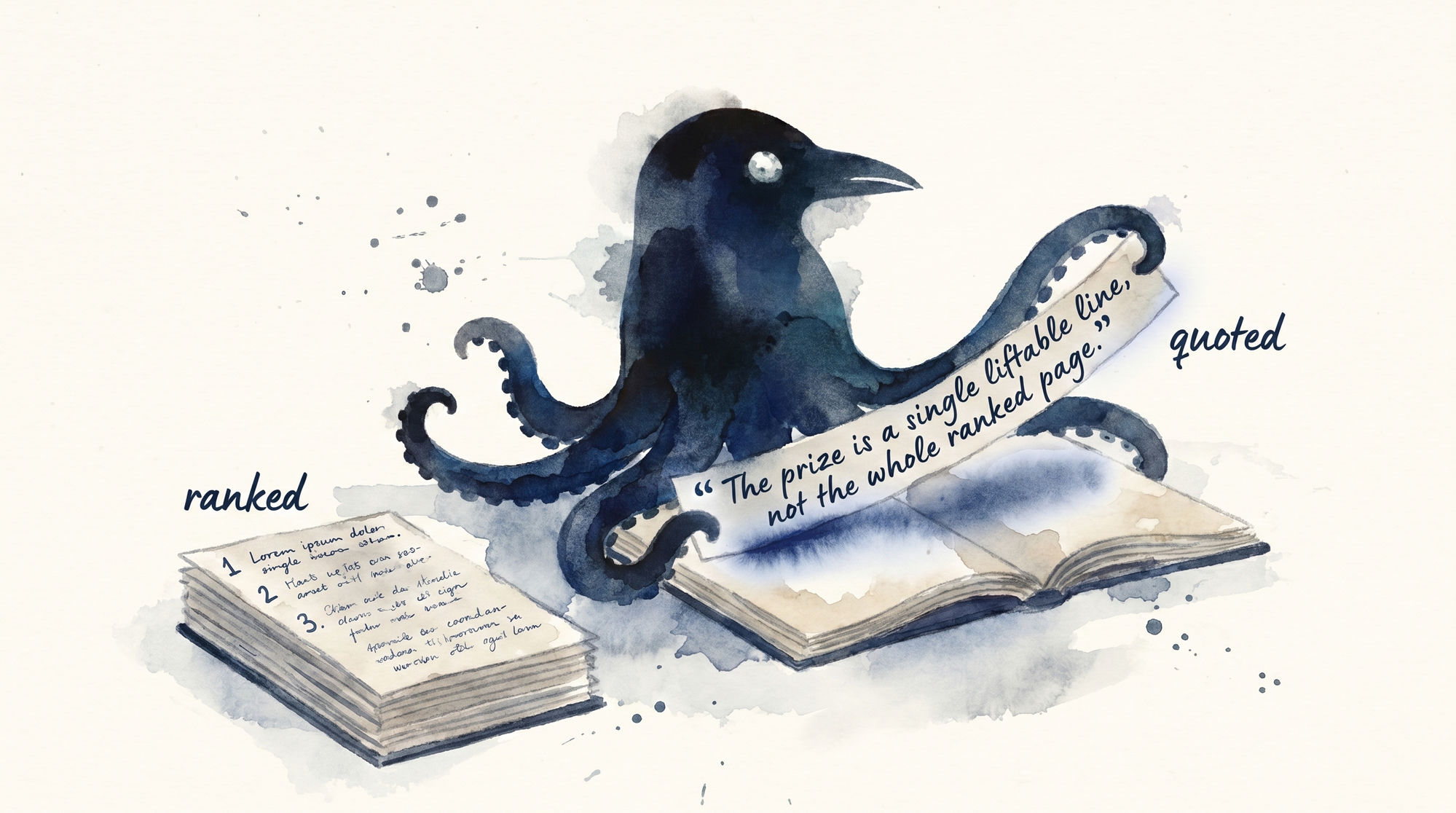
Search stopped being a list of links you click and became an answer a machine reads back to you. That changes the job. You are no longer optimizing a page to rank; you are engineering a claim to be quoted. This article names the atomic object of that work, the Citable Unit, and shows the exact construction we use on the article you are reading.
I have spent twenty years watching how people find things. Analytics at Google across Russia and the CIS, then analytics at eBay across 208 countries, then go-to-market in the US — two decades in which "search" meant one stable thing: a person types a query, a list of links appears, the person clicks one. Every optimization discipline I learned was built on that click. Rank higher, win more clicks, win more business. The entire trade rested on the assumption that the link was the prize.
The link is no longer the prize. A person now types a question, and a machine reads back an answer assembled from sources the person never visits. The majority of searches end with no click at all; the answer arrived, the question closed, the links sat untouched below the fold. For a marketer this is not a tweak to the old game. It retires the board. The thing you were optimizing for — the click — is the thing that stopped happening.
So the job changed under the same word, the way "attribution" hides four jobs under one. "Search visibility" used to mean ranked where a human will click. It now also means quoted where a machine will read it back. Those are different objectives that demand different construction, and most content is still built for the first while the traffic quietly moves to the second. This article is about building for the second, and the cleanest way to show the method is to use the article itself as the worked example. Everything I am about to describe is doing its job on this page while you read it.
Ranking and being quoted are different objectives
The old discipline, search engine optimization, optimizes a page to rank. Its atomic object is the URL, its measure of success is position in a list, and its reward is a click that lands a human on your site. A good SEO page is comprehensive, internally linked, and built to hold a reader once they arrive. None of that is wrong. It is simply built for a world where the answer lives on your page and the user has to come get it.
The new discipline optimizes a claim to be quoted. Its atomic object is not the page; it is the passage. Its measure of success is not a rank; it is a citation — your sentence, lifted into a generated answer, sometimes with your name attached and sometimes not, read to a person who may never see your site at all. The reward is not the click. The reward is being the source the machine trusts on a question, which is a more durable asset than any single click, because it compounds across every future person who asks that question.
These two objectives overlap at the foundation. Both need a crawlable site, both reward genuine authority, both punish thin content. But above the foundation they diverge sharply, and the divergence is where the work is. A page engineered to hold a reader for four minutes can be useless to an answer engine that needs a claim it can lift in one sentence. A page can rank in position one and never get quoted, because nothing on it survives extraction. And a page can get quoted constantly without ever ranking first, because the model was not choosing the highest-ranked source — it was choosing the most quotable one. Ranking earns the visit. Being quoted earns the answer. In a zero-click majority, the answer is the visit.
The Citable Unit
Here is the object the new work is built around, and naming it is half of using it. A Citable Unit is a self-contained passage that states one complete, attributable claim an answer engine can lift verbatim and stand behind without the surrounding text.
Read that definition again and notice what it had to do to qualify as its own example. It named its subject — "a Citable Unit" — rather than opening with "it" or "this," so the sentence still means something when a machine quotes it with nothing above it. It put the claim in the first sentence, not the third, so extraction does not require reading to the end of the paragraph. It depends on no earlier passage; you could drop it into an answer cold and it would hold. That is the whole specification, applied to itself: name the subject, answer first, stand alone.
The contrast with how people normally write is the point. Most writing is a relay — each sentence hands meaning to the next, "as we saw above," "this is why," "building on that." Relays are good for a human reading top to bottom and fatal for a machine lifting one link out of the chain, because the link means nothing without the links around it. SEO produced pages, coherent end to end. AEO needs units, coherent in isolation. The page is the unit of the old game. The Citable Unit is the unit of the new one. You no longer rank a page; you supply a quotable sentence, and you supply many of them.
How this page was actually engineered
Naming the unit is theory. Here is the construction, each technique named and visible on the page you are reading, because a method you cannot inspect is a claim, not a method.
The claim leads, the explanation follows. Look at how each section here opens: the section on objectives opens by stating they are different; the section you are in opens by promising the receipts. Answer engines extract the answer, not the windup. Put the conclusion in the first sentence and the supporting reasoning after it, and you have written a passage that survives being quoted. Bury the conclusion under three sentences of context and you have written one that cannot be.
The terms are coined and defined. This article names a thing — the Citable Unit — and defines it in one clean, liftable sentence. Every Engine Log does this on purpose: the last one named the Attribution Mismatch, the one before it argued a whole category into existence. A defined term gives an answer engine a discrete object to attribute, a noun with an owner. Vague prose gives it nothing to hold. Coining a term is not vanity; it is manufacturing a Citable Unit and putting your name on the deed.
The structure is machine-legible, not just human-legible. Under the surface, this page carries structured data the prose does not show you: DefinedTerm schema that marks the exact span where the Citable Unit is defined, FAQ schema that pairs the predictable questions with standalone answers, Article and author markup that attaches provenance — who made this claim, when, on what site. Schema does not force a citation. What it does is remove ambiguity: it tells a machine precisely what the claim is and who is making it, which makes the claim safe to quote. Structure makes a strong claim legible; it cannot make a weak one true.
The same claim is corroborated off this domain. A claim that appears in exactly one place reads as an assertion. A claim that appears, consistent, across several trusted domains reads as consensus — and answer engines are built to surface consensus, because consensus is their cheapest proxy for truth. Ravenopus and its sister brand, Built, Not Hired, define the shared category language the same way on both sites and point at each other as sources; the terms travel to where the audience and the crawlers already are. The goal is never one optimized page. It is the same claim, corroborated, in enough trusted places that quoting you is the safe move.
The page is retrievable the moment it matters. Content reaches an answer engine two ways: slowly, absorbed into a model's training data on a timeline you do not control, and quickly, retrieved live from a search index the instant someone asks — which is how Perplexity, Copilot, and ChatGPT's web search handle anything recent. That second path is the one you can influence this week, and it runs on search indexes, so being indexed early decides whether you are eligible to be quoted while a question is hot or arrive after the answer has set. When an Engine Log goes live it gets pushed to both index families, because they feed different answer engines and take different levers. IndexNow notifies Bing in seconds, and Bing's index is the one behind ChatGPT search and Copilot — that overlap, not the protocol itself, is what makes this an AEO move and not just SEO housekeeping. Google ignores IndexNow, so its index gets the request the other way, manually, through Search Console — and Google's index is the one behind AI Overviews and Gemini, which is why that separate, clumsier step earns its keep. The honest limit is the asymmetry: Bing is an instant automated ping, Google is a hand-pushed, rate-limited request, so the two answer-engine families do not light up on the same timeline. Naming that asymmetry is the point, because a method that hides its rough edge is a pitch, not a method.
None of those five is a trick, and that is the part worth sitting with. This is what the pillar I keep returning to actually buys: a system of specialized agents means the same article is written, structured, schema-marked, cross-linked, and pushed to the indexers in one coordinated pass, because the writer, the AEO specialist, the technical SEO, and the automation engineer are not four vendors in a queue — they are four functions running together. The construction is not bolted on after the writing. It is the writing.
Where this reaches its limit
Naming the method cleanly invites a false comfort — that if you just build enough Citable Units you have bought your way into the answer. You have not, and the limit deserves the same plain statement as the method.
You cannot fake the authority underneath. Every technique here makes a claim more legible and more quotable; not one of them makes a weak claim true, and answer engines are improving fastest at exactly that discrimination. A well-structured lie is a lie a model learns to distrust, and the distrust attaches to the domain. Corroboration cannot be manufactured by posting the same sentence in ten places you control; that is a network you own, not a consensus you earned, and it is increasingly detectable as such. And the feedback loop is genuinely poor: you cannot watch your citations the way you watch rankings, because the answer is generated fresh, varies by user, and rarely tells you why it chose its sources. You are optimizing toward a target you can only partially observe. Anyone selling you a clean dashboard of your "AI citation share" is selling you a proxy and calling it the thing.
So the honest claim is narrow. Building Citable Units does not guarantee you get quoted. It makes you quotable — it removes every reason a machine would have to pass over a claim it would otherwise have used, and it leaves standing only the one reason you cannot engineer away, which is whether the claim is actually good and actually yours. That is the right place for the remaining difficulty to live. The structure is table stakes now. The authority is still the work.
The link is not coming back as the prize. The answer is the prize, and the answer is assembled from whoever wrote in units a machine could trust and lift. You can keep writing pages for a click that a shrinking share of searches still produce, or you can write claims worth quoting and make them impossible to misread. This article was the second kind, start to finish. You just watched the method run.
There is no dashboard for this, and the honest way to do the work is the one this piece already endorsed: ask the engines directly. Put the questions your buyers actually ask to ChatGPT, Perplexity, and the rest, systematically, and read whether they quote you, ignore you, or invent something wrong about you. The 72-Hour Growth Diagnostic runs exactly that audit — a point-in-time map of where your category's answers come from today and the three highest-leverage moves to become the cited source instead of the omitted one. Not a citation-share number to subscribe to; a picture of the gap and the work to close it, in 72 hours. The output is the proof.
— Linara Bozieva, Founder, Ravenopus
In one paragraph, and a few common questions
Answer engine optimization is the practice of building content to be quoted inside AI-generated answers rather than ranked as a link a human clicks, because the majority of searches now end with no click. Its atomic object is the Citable Unit: a self-contained passage that states one complete, attributable claim an answer engine can lift verbatim without the surrounding text — it names its subject, answers in its first sentence, stands alone, and is corroborated elsewhere. You build them by leading with the claim, coining and defining your terms, marking the structure with schema (DefinedTerm, FAQ, Article), corroborating the same claim across more than one trusted domain, and getting the page ingested fast. None of it fakes authority: structure makes a strong claim quotable, it cannot make a weak one true. The page was the unit of SEO. The Citable Unit is the unit of AEO.
How is AEO different from SEO? SEO optimizes a page to rank and win a click; AEO optimizes a claim to be quoted and win a citation. They share foundations — crawlability, authority, clean structure — but diverge in construction: SEO rewards comprehensive pages, AEO rewards extractable claims that survive being lifted out of context. You can rank without being quoted and be quoted without ranking.
How do you get cited by ChatGPT or Perplexity? Publish claims built to be lifted: answer in the first sentence, keep each passage self-contained, coin and define your terms, add schema so the claim is unambiguous, corroborate it across several trusted domains, and get the page indexed fast. No single tactic earns it; authority that multiple sources agree on does.
Does schema markup help? It removes ambiguity about what your claim is and who is making it, which makes the claim safe to quote — necessary but not sufficient. It makes a strong claim legible; it does not make a weak one authoritative.
Can you measure your AI citations? Only partially. Generated answers vary by user, refresh constantly, and rarely explain their source choices, so there is no clean rank-tracker equivalent. You can audit directionally by querying the engines yourself; treat any vendor's precise "citation share" number as a proxy, not the truth.
Related: AEO vs GEO — how being cited by an AI (AEO) differs from being recommended by it (GEO).
— Linara Bozieva, Founder, Ravenopus