The Authority Leak
Last issue named the method — building claims to be quoted, not pages to rank. This issue aims it at the most authoritative content operation in marketing and pulls the trigger. HubSpot built the biggest corporate blog ever and still gets passed over by the machines answering its buyers' questions. This is the gap between authority and citation — the Authority Leak — with receipts.
Last issue I named the method. The claim is the unit of answer-engine work, not the page; you no longer rank a page, you supply a quotable sentence; and a piece of content earns its place in a machine-generated answer by being built in Citable Units — passages that answer in the first sentence and survive being lifted out of context. That was the method, demonstrated on the article carrying it.
A method you only ever run on yourself is a claim, not a method. So this issue aims it at the largest, hardest target in my own field and pulls the trigger.
HubSpot runs what Ahrefs has called the biggest corporate blog ever measured by organic search traffic — bigger than Harvard Business Review, bigger than The Verge — more than eighteen thousand pages built over fifteen years to rank for every question a marketer might ask. If authority bought citations, HubSpot would be the voice inside every AI answer in marketing. It is not. On most of the questions it was built to own, the machines quote someone smaller. I want to show you exactly where that authority goes, because the place it leaks is the place the next five years of marketing budgets are headed.
Authority and citation are different properties
We have spent a decade treating authority as a single quantity — a domain rating, a backlink count, a number that goes up and supposedly drags everything good up with it. That model held while search meant a ranked list of links, because authority and ranking really were the same axis: more authority, higher rank, more clicks. The number was the game.
The number is no longer the game, because the answer is no longer a list. When a person asks a question and a machine reads back a synthesized answer, the machine has to make a second decision the old list never required: not which page ranks highest but which sentence do I quote. Those are different decisions with different inputs. Ranking rewards a comprehensive, well-linked, authoritative page. Quoting rewards a self-contained, liftable claim. A domain can win the first decision overwhelmingly and lose the second one completely, on the same query, at the same moment. Authority earns the rank. It does not earn the quote.
That gap has a shape and it deserves a name.
The Authority Leak
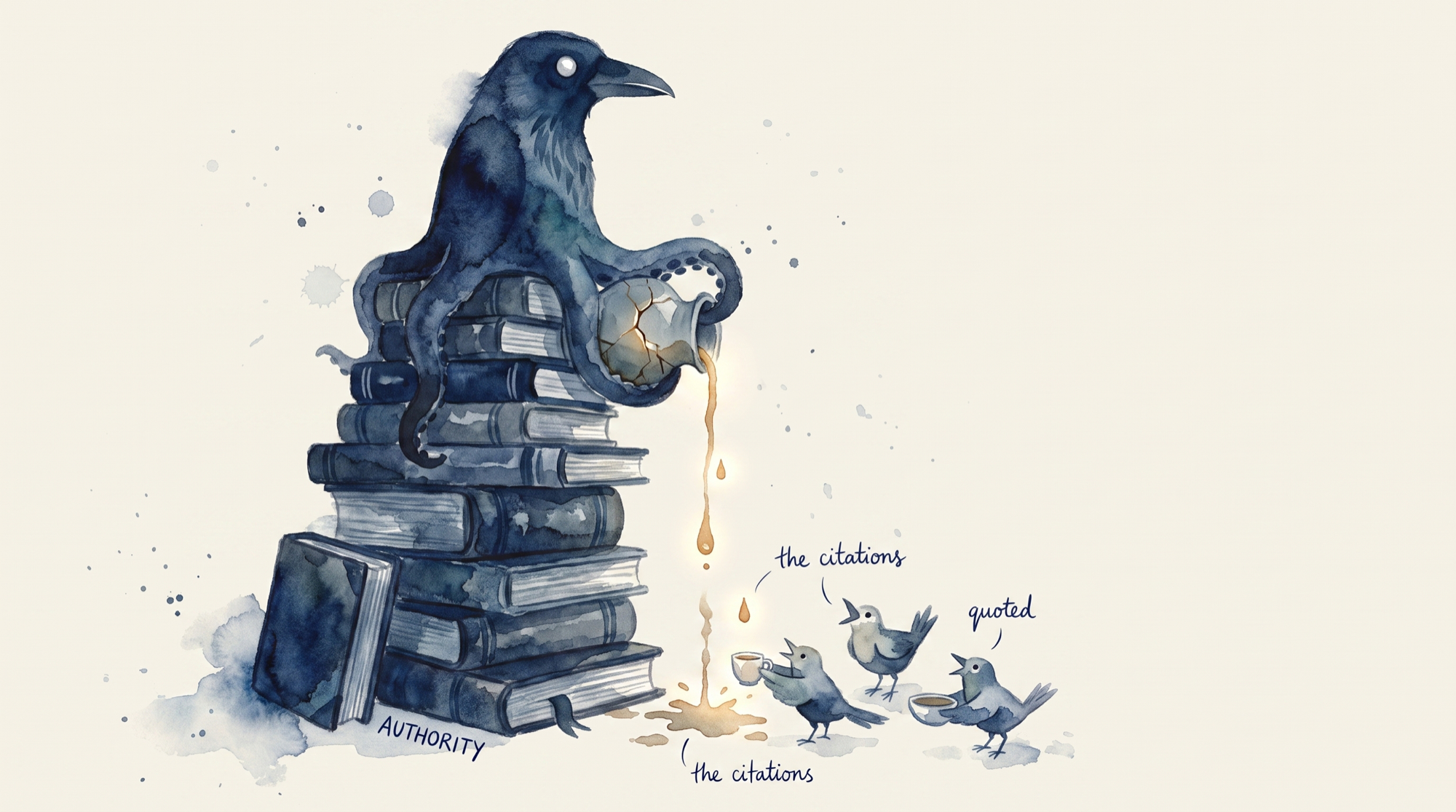
An Authority Leak is the gap between a domain's ranking authority and its answer-engine citation rate — when a high-authority site fails to be quoted by AI answer engines because its pages are not built as liftable, self-contained claims, so the citation flows instead to smaller, better-structured sources.
Notice what the leak is not. It is not losing your rankings; you can hold position one and still leak every citation, because the quote is chosen in a layer above the blue links, from sources the ranking did not decide. It is not a reputation problem; the authority is real, earned, and intact. The leak is mechanical: the authority exists, the page ranks, and yet when the machine assembles its answer it reaches past you to a source that stated the claim in a form it could lift. You did the expensive work of becoming trusted, and a smaller site collected the dividend because it did the cheap work of being quotable. The backlinks bought the rank. The structure buys the quote, and you skipped it.
The teardown
Here are the receipts, captured 24 June 2026. Two caveats stated up front, because a teardown that hides its limits is a hit piece, not a diagnostic: answer-engine outputs vary by user, session, and time, so these are a point-in-time snapshot, not a constant; and because the AI Overview boxes and the ChatGPT and Perplexity citation panels have to be read by a human rather than scraped, I read each by hand and summarize the results below.
First, the authority is not in dispute. HubSpot's blog drew an estimated 8 to 10 million organic visits a month at its 2024 peak (Ahrefs), across more than eighteen thousand pages. It ranked for so much that some of its biggest traffic came from pages like a list of famous quotes and a guide to typing the shrug emoji — content the SEO analyst Aleyda Solis later flagged as topically miles from anything HubSpot sells. This is the most successful execution of the rank-for-everything playbook in the history of B2B content. Hold that as the baseline.
Second, that baseline is collapsing — and the reason matters for honesty. Over eleven months in 2024, HubSpot's blog fell from about 77 percent of the company's organic search traffic to 42 percent, its top-three ranking keywords dropped roughly 78 percent year over year, and three independent tools put the overall organic decline near 80 percent (Solis, January 2025; Surfer SEO, April 2025). I want to be precise about cause, because the lazy version of this story is wrong: the named analysis attributes the collapse primarily to Google's own 2024 core and spam updates penalizing broad, search-first content, with AI answers as a compounding pressure — not as the sole killer. The honest reading is convergence. HubSpot built maximum authority on broad informational content, and that is exactly the content category that Google's updates and the AI answer layer are devaluing at the same time, for the same underlying reason: it is no longer the scarce, trusted thing it was.
Third — and this is the leak itself — on the questions HubSpot was built to own, the answer layer quotes other people. I ran eight high-intent marketing questions a buyer actually types — what is a good email open rate, how to calculate customer acquisition cost, what is marketing attribution, best time to post on Instagram, what is a good conversion rate, how to reduce churn, what is product-led growth, lead scoring best practices — across three answer engines: Perplexity, Google's AI Overview, and ChatGPT with web search on. Twenty-four answers in all. HubSpot has strong, ranking content on every one of those questions. It was cited in two of the twenty-four answers. Both were on Perplexity — marketing attribution and customer churn — and on those very same two questions, Google's AI Overview and ChatGPT each reached past HubSpot to quote someone else. Google's AI Overview fired on all eight queries and cited HubSpot on none of them, assembling its answers from monday.com, Sprout Social, ProductPlan, Amplitude, Pendo, Statista, and in several cases Reddit and Wikipedia. ChatGPT cited it zero times too. Take the one query HubSpot might most expect to own — "what is marketing attribution," a concept it has documented for the industry for a decade: Perplexity granted it a single citation alongside Amazon, Adobe, and Wikipedia; ChatGPT built its answer from AdRoll, Adobe, Search Engine Journal, and two academic papers; Google quoted others entirely. The most authoritative marketing publisher on the internet, quoted on two of twenty-four answers to the questions it was built to own. That is an Authority Leak you can watch happen in real time.
A few exhibits from the audit (captured 24 June 2026, signed out where possible; answer-engine outputs vary by user, session, and time):
- Perplexity, "what is marketing attribution": HubSpot appears — but as one source among Amazon Ads, Adobe, Supermetrics, and Wikipedia.
- Google's AI Overview, "what is a good email open rate": cites monday.com, MeetTie, and Reddit. HubSpot absent.
- ChatGPT, with web search, "how to reduce customer churn": cites SuperOffice, Guideflow, Cuoral, Reddit, and Churn Buster. HubSpot absent — even though Perplexity cited it on the very same question.
The mechanism, in HubSpot's own words
Why does the most authoritative source lose the quote? Open the pages and the answer is right there in the first paragraph — or rather, the answer is not there in the first paragraph, which is the whole problem.
Here is how HubSpot's email-benchmark page opens, the page that should own "what is a good email open rate." Verbatim: "Email marketing is only effective if customers actually open messages. While results vary by industry, top-performing campaigns achieve open rates of above 40%..." — followed by two more paragraphs about list quality, a plug for HubSpot's tools, and a preview of what the post will cover, before the actual benchmark table appears. An answer engine reading the first two hundred words of that page gets a vague effectiveness claim, a product mention, and a table of contents. There is no sentence it can lift that answers the question.
The lead-scoring page is cleaner but commits the single most anti-quotable move in web writing. It opens with a sales anecdote about tire-kickers, then: "In this article, I'll share lead scoring models for you to consider..." The definition of lead scoring — which is clean, correct, and perfectly liftable — arrives in the third paragraph, behind a sentence whose only job is to announce that the answer is coming. "In this article, I'll share" tells a machine the page is about to answer the question instead of answering it. The churn page does the same with a first-person story about brand loyalty before it defines the term.
None of this is bad writing. It is excellent writing — for a human skimming a page in 2018, where a warm hook and a preview earned dwell time and dwell time earned rank. It is the house style of the entire content-marketing era, and HubSpot taught it to the rest of us. But the answer engine does not skim and does not warm up. It extracts the first self-contained claim it can stand behind, and HubSpot's pages routinely open with things that are not claims: anecdotes, previews, product mentions. The competitor that wins the quote isn't more authoritative. Its page is just titled with the question and led with the number. That is the entire difference, and it is worth millions of answers.
Where the authority leaks to
The citation does not vanish. It flows somewhere, and the direction is the strategic point. BrightEdge's 2025 analysis found that between 48 and 77 percent of AI citations go to specialized sites beyond the major platforms — industry publications, niche experts, topic-specific resources. The citation pools are enormous and skew small: Perplexity drew from over eight thousand unique domains in their study, against ChatGPT's roughly two thousand. The machine is not looking for the biggest brand. It is looking for the most liftable claim, and specialists who write narrowly tend to answer directly, which is exactly the structure that gets lifted.
This is the part that should reorganize a budget. For fifteen years the winning move in content was to accumulate authority — outspend, out-publish, out-link the category until your domain was too big to ignore. That asset still has value, but it no longer automatically converts into presence inside the answer, and the answer is where a growing majority of questions now end: 68 percent of US Google searches ended without a click in early 2026 (SparkToro, on Similarweb data), with AI Overviews appearing on more than a fifth of searches and cutting click-through roughly 60 percent where they appear. The traffic is moving into a layer that rewards a property — quotability — that authority does not buy and money cannot shortcut. A two-person company that writes in Citable Units can be quoted on the same query where a domain with eighty-five million backlinks is not. I find that genuinely exciting, and not because I want to see HubSpot lose. I don't. I want you to see that the moat everyone spent a decade digging does not protect the new position, and the new position is open.
Where this reaches its limit
The clean version of this argument overshoots, so let me pull it back to what the evidence actually supports.
Authority is not dead; it is leaking. Large, trusted brands still get cited often, and trust still matters enormously — an answer engine would rather quote a credible source than an anonymous one, all else equal. The claim is narrower and more useful than "authority stopped working": authority no longer guarantees the citation the way it once guaranteed the rank, because a second filter — quotability — now sits between authority and the answer, and that filter is one most large content libraries fail by construction. HubSpot is not uniquely bad here; it is uniquely visible, because it built more of the old kind of content than anyone, so it has more to leak.
Two more honest limits. My eight-query, three-engine audit is a snapshot, run on one day from one place, in a layer that changes by the hour and by the user — directional evidence, not a benchmark, and the exhibits above are there so you can check my read rather than take it. And HubSpot itself is already responding: it has shipped an AEO grader and published its own tutorials on writing for AI citation, which describe — accurately — exactly the construction its legacy pages lack. That is not a company that missed the shift. It is a company carrying fifteen years of pages written for the previous one, doing the slow work of turning the ship.
There is a tidy proof of this whole distinction inside that grader. I ran HubSpot through its own tool, and it scores 85, 78, and 86 out of a hundred across ChatGPT, Perplexity, and Gemini — "great," the tool says — carried by near-perfect brand recognition and sentiment. And it should: the models plainly know HubSpot and think well of it. But that score measures recognition — whether the models know and respect the brand — not citation — whether they quote its pages when they answer a buyer's question. HubSpot earns a mid-eighties on the first axis and a two-of-twenty-four on the second, and the distance between those numbers is the Authority Leak, measured for once by the company's own instrument. Recognition was never the thing in doubt. Being quoted is.
The lesson is not that HubSpot was foolish. It is that being early and enormous in the last paradigm is its own kind of debt in the next one, and that debt is measured one un-quotable opening paragraph at a time.
The answer is the prize now, and the answer is assembled from whoever wrote in claims a machine could lift. Authority gets you considered. It does not get you quoted. The gap between the two is the Authority Leak, and right now it is wide open on the most authoritative content in my industry. That is either a warning or an invitation, depending on how your pages open.
You cannot fix a leak you cannot see, and there is no rank-tracker for this — the citation happens in a layer the old tools do not read. The honest way to measure it is to ask the engines directly: put the questions your buyers actually type to ChatGPT, Perplexity, and Google's AI Overviews, systematically, and read whether they quote you, ignore you, or quote someone smaller instead. The 72-Hour Growth Diagnostic runs exactly that audit on your domain — a point-in-time map of where your category's answers come from today, which of your pages leak and why, and the highest-leverage rewrites to become the cited source instead of the omitted one. Not a citation-share number to subscribe to; a picture of the gap and the work to close it. The output is the proof.
— Linara Bozieva, Founder, Ravenopus
In one paragraph, and a few common questions
An Authority Leak is the gap between a domain's ranking authority and its answer-engine citation rate — when a high-authority site fails to get quoted by AI answer engines because its pages are not built as liftable, self-contained claims, so the citation flows to smaller, better-structured sources instead. HubSpot runs what Ahrefs called the biggest corporate blog ever measured, more than eighteen thousand pages; its organic traffic fell roughly 80 percent through 2024 (primarily from Google's own core updates, with AI answers compounding it), and in a point-in-time audit across three answer engines and eight high-intent marketing queries — twenty-four answers — it was cited in just two, while smaller specialists captured the rest. The mechanism is visible in the pages themselves: they open with hooks, previews, and product mentions instead of the liftable answer, because they were written for a human-engagement era and for Google's old ranking signals. Between 48 and 77 percent of AI citations now go to specialized sites beyond the major platforms, while 68 percent of US searches end without a click. Authority earns the rank; structure earns the quote — and the gap between them is wide open.
Why do big authoritative brands get ignored by AI search? Because answer engines quote the most liftable passage, not the most authoritative page. Most large libraries were built for human engagement and old ranking signals, so they open with hooks and previews rather than self-contained claims — and the citation leaks to specialists who answer directly.
Did AI kill HubSpot's traffic? No, not by itself. The named analysis attributes the collapse mainly to Google's 2024 core and spam updates penalizing broad, topically misaligned content, with AI Overviews as a compounding pressure. The honest framing is convergence, not a single cause.
How is a leak different from losing rankings? Losing rankings is falling down the list of links. An Authority Leak is being absent from the generated answer above the list, even on queries you still rank for. Rank trackers cannot see it because it happens in a layer they do not read.
How do you stop it? Rebuild the openings: lead with the liftable answer, keep each passage self-contained, coin and define your terms, mark the structure with schema, and corroborate the claim off-domain. At scale it is an institutional debt problem; the first step is measuring the leak by querying the engines your buyers use.
— Linara Bozieva, Founder, Ravenopus