The Velocity Dividend
Every operator running this model says the same sentence: we ship in days what used to take months. Buyers hear a convenience claim — the same work, sooner — and a convenience claim can be matched by anyone willing to hire more people. That reading hides the actual mechanism. Speed is not how fast the work arrives; it is how fast you find out whether you were right. Shipping is a question put to reality, so the rate at which you ship is the rate at which you get answers, and answers compound where output only adds. This is the Velocity Dividend, and it is paid in calibration.
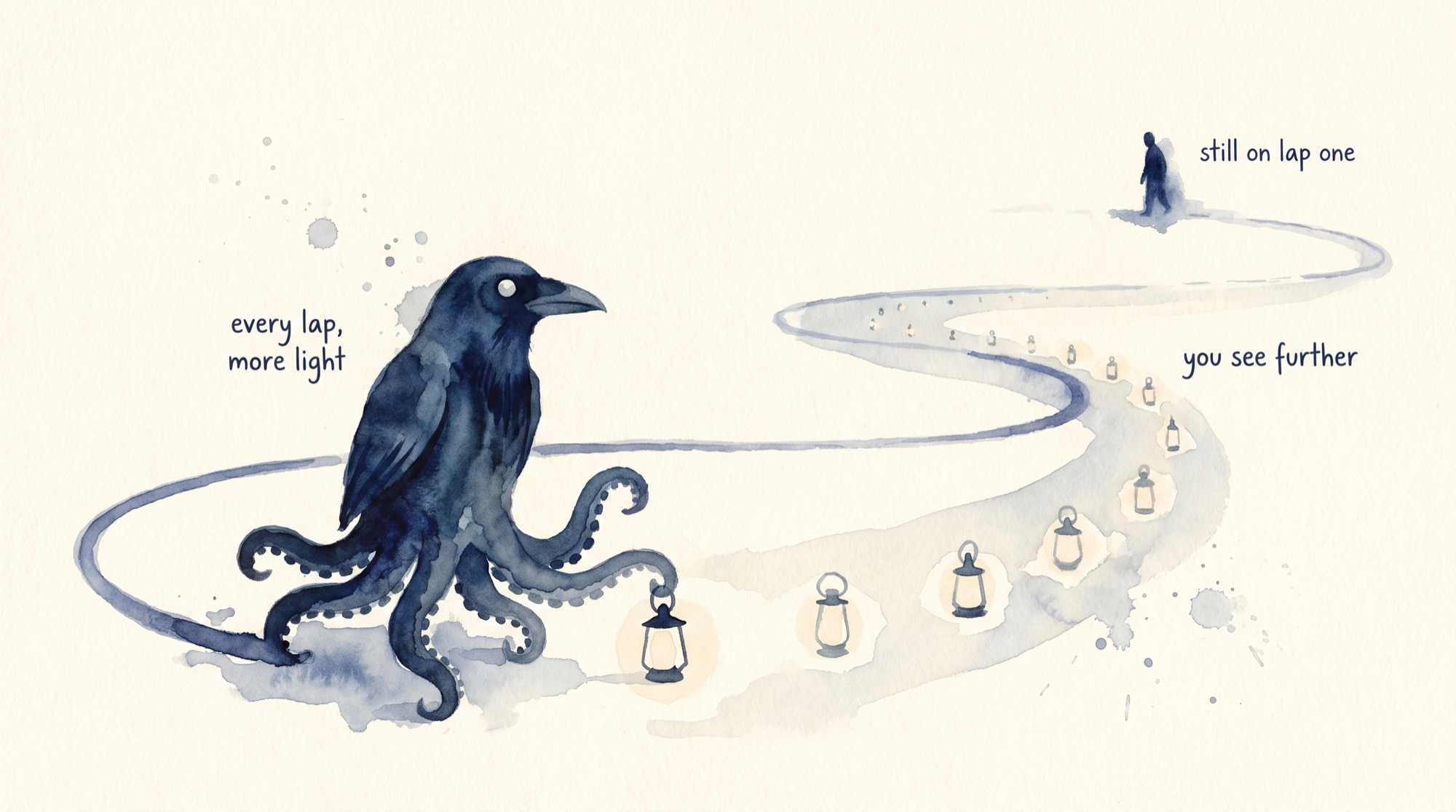
Every operator running this model says some version of the same sentence: we ship in days what used to take months. I have said it. It is the most underpriced claim in the pitch, and it is underpriced because of how it lands.
Buyers hear a convenience benefit. Sooner. The same work they already buy, with less waiting — the way overnight shipping is a nicer version of ground shipping. That reading turns speed into a feature, and features get matched. If speed only means the deliverable arrives earlier, then any agency willing to hire more people or work later can close the gap, and the advantage was never structural to begin with.
I think that reading is wrong, and wrong in a way that hides the actual mechanism. Speed is not how fast the work arrives. Speed is how fast you find out whether you were right. That is not a convenience, and it does not stay the same size.
What faster is actually buying
Start with what a shipped thing is.
The industry treats a campaign, a page, an ad variant, a teardown as a deliverable — an object with value in itself, handed over and invoiced. That framing is a holdover from the era when producing the object was the expensive part, which is the thing the last issue argued has now collapsed. Once execution costs almost nothing, the object stops being the point. Every shipped asset is a question put to reality: is this the claim that lands, is this the audience that converts, is this the offer they actually wanted rather than the one we assumed. The market answers. The answer is the asset. The artifact was only ever the instrument for extracting it.
Read it that way and the rate at which you ship is the rate at which you get answers. That is a learning rate, not a delivery schedule. And learning rates behave differently from output rates in one decisive respect: output adds, learning multiplies.
Output is a stock. Ten cycles of production give you ten things, and eleven cycles give you eleven — each one independent of the last, each one worth roughly what the first was worth. Learning is not like that, because every cycle's decisions are made from the priors the previous cycle corrected. The eleventh question you ask the market is a better question than the first, not because you got smarter in the abstract, but because ten answers narrowed the space it was drawn from. You are not repeating the loop. You are entering each pass with a better map than you had on the last one.
The gap that compounds
Take two operations with the same budget, the same market, and the same starting intelligence. One closes four cycles a quarter. The other closes forty.
The naive comparison says the second has ten times the output, and if output were the product that would be the entire story — a linear gap, unpleasant but bridgeable, and closable at any point by anyone willing to spend on capacity. But that is the smaller of the two gaps, and it is the one everybody looks at.
The larger gap is that the second operation has put ten times as many questions to the market and received ten times as many answers, and each of those answers moved its priors before the next question was asked. At the end of the year the difference between them is not a pile of assets. It is that one of them is making decisions from a model of its market that has been corrected forty times, and the other from a model corrected four times. Every subsequent decision the fast operation makes is drawn from better information — including the decision about what to test next, which is where most of the real leverage in marketing has always been.
This is what makes the gap hard to close rather than merely large. Production capacity is purchasable. It is available tomorrow, at a price, to anyone. Feedback that was never collected is not purchasable at any price, because it does not exist — the market's answer to a question you did not ask in March is not sitting somewhere waiting to be bought in September. A slow operation that wakes up and buys its way to throughput parity has bought the smaller half. It still starts from uncalibrated priors and has to run the cycles to earn the rest, during which the fast operation is not standing still. Capacity can be acquired. History has to be lived.
The slow loop does not just learn less — it learns wrong, and it learns late
There is a second effect, and it is the one I most want to put on the record, because it is worse than the first.
A slow loop does not simply produce fewer answers. It produces answers of lower fidelity, and for most operations it does it structurally.
When the interval between a decision and its result is six weeks, everything else in the world also gets six weeks to move. Competitors change their offers. Seasonality turns. Ad auctions reprice. The algorithm updates. Your own other work ships into the same market. By the time the result arrives it is not the answer to your question — it is the answer to your question plus every confounder that accumulated while you waited. You are reading a signal through six weeks of noise and attributing all of it to the one thing you changed — a causal claim resting on an observation that cannot carry one, which is the same family of error the attribution issue is about, arriving by a different route. The longer the loop, the more contaminated the read, and the more confidently wrong the lesson you draw from it.
There is an honest objection here, and it is right. Run a real holdout — a comparable slice of audience or geography withheld from the change, measured over the same window — and the confounders stop mattering. The competitor's new offer, the seasonal turn, the algorithm update: all of it lands on both arms and differences out. That is the entire reason holdouts exist, and a six-week controlled test is not a worse measurement than a six-day one. On sample alone it is a better one.
So this is not an argument against long tests. It is an argument against the thing most operations run instead of one — a before-and-after read, no control arm, the difference called a result. That read has no protection at all, and every week of interval is another week in which the world quietly writes itself into the number you are about to act on.
But grant the holdout, run it properly, and the deeper problem does not disappear. It moves. A clean experiment tells you what was true of the world it ran in; it cannot tell you that world is still there when the answer finally reaches a decision. Control groups defend the measurement. Nothing defends its shelf life.
And the decay begins before you can even spend it. The lesson goes into the next cycle, which takes its own six weeks to build and ship and its own interval to answer. By the time the knowledge is converted into a decision that actually reaches the market, it is describing a market that has moved twice since it was collected. This is the part I have not seen argued anywhere. What a cycle teaches you is perishable, and a slow loop keeps arriving after the expiry date. This is also where the compounding claim quietly fails on the slow side: learning multiplies only if each cycle begins from priors that are still true, and priors collected two intervals ago are not corrections any more — they are history. So the fast operation is not only collecting more answers. It is collecting them while they are still true, and spending them while they still describe something. If your cycle time is longer than the shelf life of what a cycle teaches you, no amount of rigor inside the cycle rescues it. You are steering by a picture of a market that no longer exists, and you will be permanently, because the only thing that would fix it is the interval itself.
Given long enough, an operation can be busy, expensive, thorough, and steadily getting further from an accurate picture of its own market. It will not feel like that from the inside. It will feel rigorous.
The Velocity Dividend
So the thing speed pays out is not the thing it is sold as.
The Velocity Dividend is the compounding advantage that accrues from the rate at which an operation closes feedback loops rather than the rate at which it produces work. It is paid in calibration, not in volume. It is visible in the quality of the next decision, not in the size of the last delivery. And it does not appear on any of the surfaces the market currently uses to evaluate a marketing partner, which is precisely why it is mispriced.
Look at what a buyer is shown. Deliverables per month. Hours. Headcount on the account. Turnaround time, framed as service quality. Every one of those meters production, and production is the input that stopped being scarce. None of them ask the only question that predicts whether the engagement will be smarter in six months than it is today: how many times will this operation find out it was wrong, and how quickly. A partner that closes twenty honest loops a quarter and a partner that closes two look nearly identical on a scope of work. They are not remotely the same asset, and the difference between them widens every month the contract runs.
The lag between what the market measures and what actually compounds is the opportunity, in the same way and for the same reason that the mispricing of judgment is. They are the same phenomenon seen from two angles: when execution stops being the constraint, everything downstream of execution — what you choose to make, and how fast you find out whether it worked — becomes the whole game, and none of the old instruments were built to see either one.
Why this is structurally the operator's game
The reason a queue destroys velocity is not that people in queues work slowly. It is that a queue is, by construction, latency inserted between a decision and its answer.
Work waits for a specific person to become free. Then it waits for review. Then it waits for the client's Thursday call, because that is when decisions are made. None of that interval is thinking; it is work sitting still. And every hour of it is added directly to the length of the feedback loop, which means it is subtracted from the fidelity of what you eventually learn. A queue does not just slow the calendar. It degrades the information the calendar was supposed to produce.
This is worth being exact about, because there is an ugly version of this argument and I do not want to be read as making it. Nobody is being asked to work faster. The hours removed by this model are not anyone's labor — they are the intervals in which work sat in a tray waiting for a human to become available, which were never anyone's craft and were never valuable to the person waiting either. Compressing the wait between decisions is a completely different act from compressing the thinking inside one, and only the first is on offer here. The thinking is the part you protect with the time the waiting used to consume.
An operator with agents underneath does not have the wait states, so the loop closes at the speed of the decision rather than the speed of the calendar. That is the entire structural claim, and it is why the dividend accrues to this shape of operation rather than to a more energetic version of the old one.
Where this reaches its limit
Three limits, and the first one is load-bearing enough that the rest of the argument fails without it.
Velocity without honest measurement compounds confidence, not knowledge. The entire mechanism rests on each cycle closing with a real read on what happened. Remove that and iteration stops being learning and becomes churn with good morale: you accumulate cycles, mistake the accumulation for evidence, and end the year with strong opinions built from nothing. This is why attribution is not a separate topic from velocity but a precondition for it. A fast operation that does not measure honestly is not compounding a dividend. It is compounding an error, faster than a slow one could, and it will hold that error with more conviction because it has so many cycles behind it.
Not every loop is compressible, and pretending otherwise is its own failure. Some latency belongs to the world, not to your process. An enterprise sales cycle answers on its own schedule. Indexation and AI-answer visibility take the time they take. Brand perception moves slowly and is supposed to. Firing ten times faster into a loop that answers in ninety days does not give you ten times the learning; it gives you ten unfalsified guesses in flight at once, and a strong temptation to read the noise between them as signal. The discipline that makes this usable is to ask, of each loop you run: how much of this delay is the world's response time and how much is my own waiting? Compress the second without mercy. Respect the first, and slow your read to match it.
Speed multiplies judgment, including bad judgment. Velocity is a coefficient, not a direction. Applied to a wrong idea it gets you to the wrong place sooner and with more of the budget spent, and the dividend runs negative — the compounding works identically in reverse. This is where this argument and the last one hold each other up: taste without velocity is a good decision made too rarely to matter, and velocity without taste is an efficient route to being confidently wrong at scale. The pair is the point. Neither half is worth much alone.
For a long time the industry measured a marketing partner by what arrived and when, because production was scarce and everything above it was invisible. Production is not scarce now. What is scarce is an operation that finds out it was wrong quickly enough for the correction to still be worth something — and that has been running long enough for the corrections to have added up. The output gap is what a buyer can see. The learning gap is what they are actually choosing between.
In one paragraph, and a few common questions
In one paragraph: Operators who run this model say they ship in days what used to take months, and buyers hear a convenience claim — the same work, sooner — which is both wrong and the reason the advantage is underpriced. Once execution is nearly free, a shipped asset is not a deliverable but a question put to the market, so how fast you ship is how fast you get answers: a learning rate, not a delivery schedule. Output adds and learning multiplies, because each cycle begins from priors the last one corrected, so two operations with the same budget diverge not by a pile of assets but by how many times their model of the market has been checked against it. That gap resists closing, because production capacity can be bought tomorrow while feedback never collected cannot be bought at all. Worse for the slow side, long loops do not just yield fewer answers but, absent a control arm, dirtier ones — six weeks of confounders get attributed to the one thing you changed — and even a clean answer perishes before it can be spent, because acting on it takes another full interval and lands in a market that has moved again, so a slow operation can be rigorous, expensive, and steadily getting further from the truth. That compounding return on loop speed is the Velocity Dividend, paid in calibration rather than volume, invisible on every instrument the market currently uses to evaluate a partner. It is structurally the operator's game because a queue is latency inserted between a decision and its answer, and the hours it removes were wait states, not anyone's labor or craft. The limits are real: without honest measurement velocity compounds confidence instead of knowledge; loops whose latency belongs to the world cannot be compressed by shipping harder; and speed is a coefficient, so applied to bad judgment it runs the dividend negative — which is why velocity and taste are worth almost nothing apart.
What is the Velocity Dividend? The compounding advantage that comes from how fast you close feedback loops rather than how much you produce. Shipping is a question put to the market, so iteration speed is a learning rate, and learning multiplies where output only adds. It is paid in calibration and shows up in the quality of the next decision.
Isn't this just "move fast and break things"? No. That is a tolerance for error; this is a claim about learning from it, which requires every cycle to close with an honest read. Speed without measurement compounds confidence rather than knowledge.
Doesn't faster mean lower quality? Only if the months were spent thinking, and mostly they are not — the interval is dominated by work waiting for a specific person to be free. Removing the waiting does not remove the thinking; it removes the alibi that a long calendar and a good outcome are the same thing.
Can't a bigger operation add people and match it? More people adds production capacity, which is the constraint that already disappeared, and coordination usually adds wait states rather than removing them. Even at throughput parity, it starts from priors nobody corrected, and the feedback it never gathered is not for sale.
What if my loop is genuinely slow? Then respect it. Enterprise cycles, indexation, and brand answer on the world's schedule, not yours, and shipping faster into them buys unfalsified guesses rather than learning. Ask per loop how much of the delay is the world and how much is your own waiting, and compress only the second.
If the market keeps moving, isn't all learning perishable — including yours? Yes, and that is the mechanism rather than a rebuttal to it. Everyone's knowledge decays; what differs is whether it decays faster than you can act on it. The ratio that decides it is cycle time against the shelf life of what a cycle teaches — and shelf life is set by the market, while cycle time is the only side of it anyone controls.
— Linara Bozieva, Founder, Ravenopus